

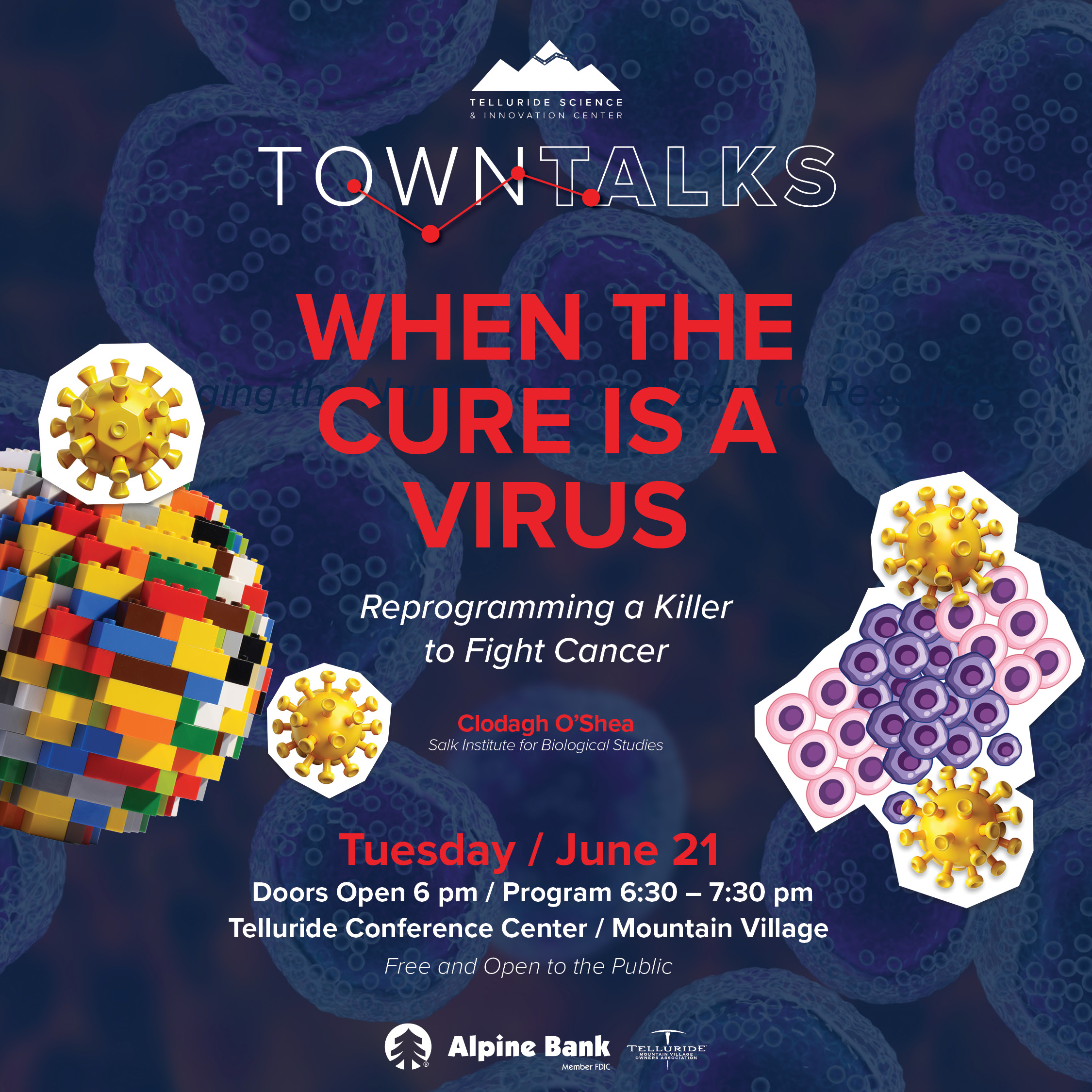
14 Jul Telluride Science Town Talks: When The Cure (to cancer & more) Is A Virus,” 7/21!
This coming week the 2026 Telluride Science Town Talks series continues with When The Cure Is A Virus: Reprogramming a Killer to Fight Cancer.” The event features Dr. Clodagh O’Shea from the Salk Institute of Biological Studies.
Talk takes place Tuesday, July 21. Doors 6 p.m.; talk, 6:30- 7:30 p.m.
Town Talks are FREE and open to the public.
Visit telluridescience.org to learn more about Telluride Science and the historic Telluride Depot, now the Telluride Science & Innovation Center. The venue is the permanent home for Telluride Science and a global hub of inspired knowledge exchange and development where great minds get to solve great challenges.
The 2026 Telluride Science Town Talks series is presented by Alpine Bank with additional support from the Telluride Mountain Village Owner’s Association.
Go here for more about Telluride Science.
Go here for more on Town Talks.
And please note: Next up is a very special Town Talk, “The Dual Challenge, Climate and Energy.” The panel discussion takes place on Tuesday, July 28 at the Sheridan Opera House.
LEGOs and cancer-fighting machines. Natural bedfellows?
At the Salk Institute, Dr. Clodagh O’Shea is proving otherwise. By snapping together pieces of DNA the way a child snaps together those plastic bricks, she is building weapons against cancer.
Viruses are nature’s nanomachines. Their unique structure allows them to target specific cells into which they release proteins that hijack the cell’s ability to control growth, instead forcing it to make endless copies of the virus. O’Shea discovered those are the same growth controls cancer also hijacks, so she decided to fight fire with fire, redesigning viruses to act as guided missiles, programmed to infect cancer cells only.
But when the virus infects one cancer cell, it does not stop there. Exponentially more bad actors are killed as the virus replicates inside them, and then bursts them open, releasing thousands of new viral copies that go hunting for the next tumor cell.
What is even more impressive: the engineered viruses can be easily rebuilt to target different cancers.
Just like LEGOs.
In her Telluride Science Town Talk on July 21, “When The Cure Is A Virus: Reprogramming a Killer to Fight Cancer,” O’Shea will explain how these engineered new virus can change the way we treat cancer.
Yes, as you may have guessed O’Shea’s approach is similar to immunotherapy, a medical intervention we have already come to know and trust.The key difference? Instead of unleashing the immune system to hunt down cancer, O’Shea’s synthetic viruses do the hunting themselves because, as you may recall, they are engineered from the ground up to recognize and destroy tumor cells directly.
And here’s further good news: O’Shea’s therapies are already in human clinical trials.
Join Dr. O’Shea to find out how something as small as a virus, built the way you would build a LEGO set, can defeat cancer.
Dr. Clodagh O’Shea, more:
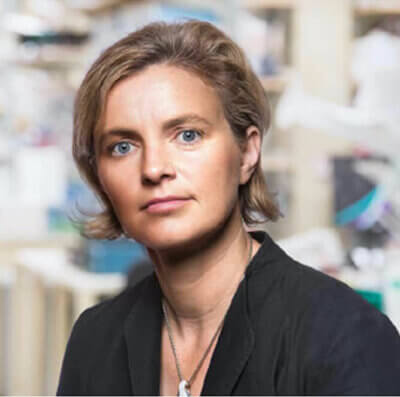
Dr. Clodagh O’Shea, courtesy Telluride Science.
Clodagh O’Shea is the Scientific Founder of IconOVir Bio and Chair of IconOVir’s Scientific Advisory Board. She is also the Wicklow Capital Chair and Professor of Molecular and Cell Biology at the Salk Institute, a Howard Hughes Medical Institute Faculty Scholar, Allen Distinguished Investigator, Adjunct Professor at UCSD and Director of the Redesigning Biology and Medicine Initiative.
Dr. O’Shea did her BSc in Biochemistry at University College Cork and her PhD in Immunology at the I.C.R.F. (Crick Center) and Imperial College London. Her interest in cancer and viral engineering was seeded during her postdoctoral training as a Human Frontiers Fellow at UCSF where she revealed the underlying molecular mechanisms of action of the first generation of oncolytic virus therapies and novel tumor/viral targets.
Dr. O’Shea joined the faculty at the Salk Institute in 2007 where she established a highly interdisciplinary and innovative research program. She was promoted to Associate Professor in 2013, and Full Professor in 2018.
Caroline Simmons, more:
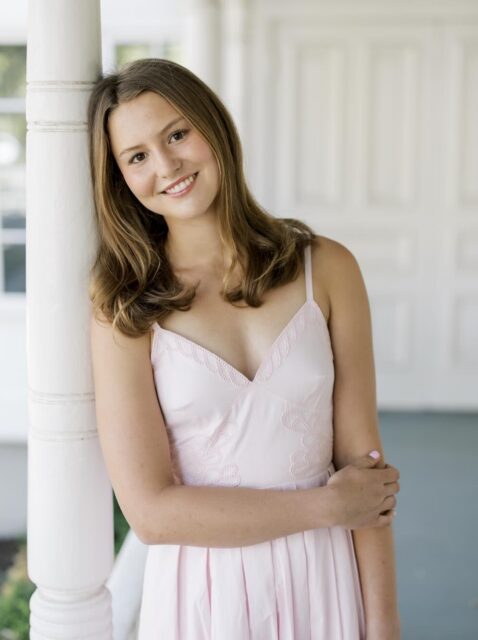
Caroline Simmons is from Austin, Texas, and has grown up spending as much time in Telluride as possible.
She is a rising second-year at the University of Richmond, where she plays field hockey and is planning on studying Biology and Health Studies.
Sorry, the comment form is closed at this time.