

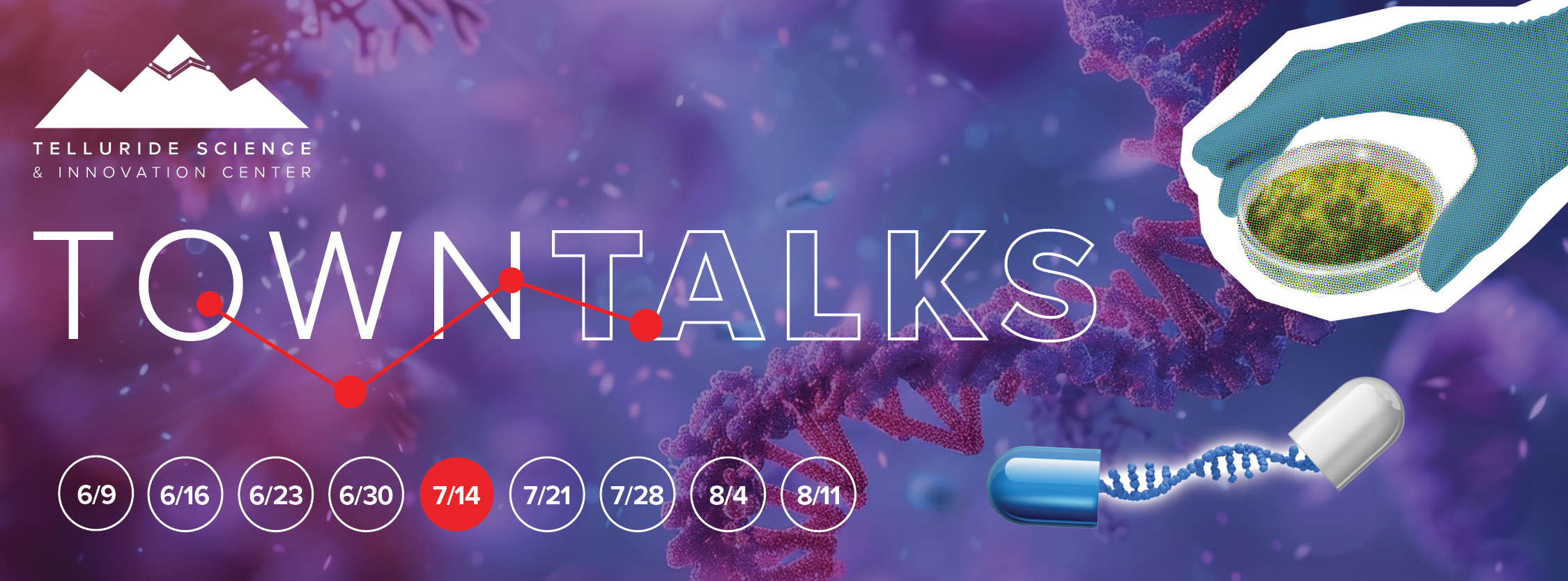
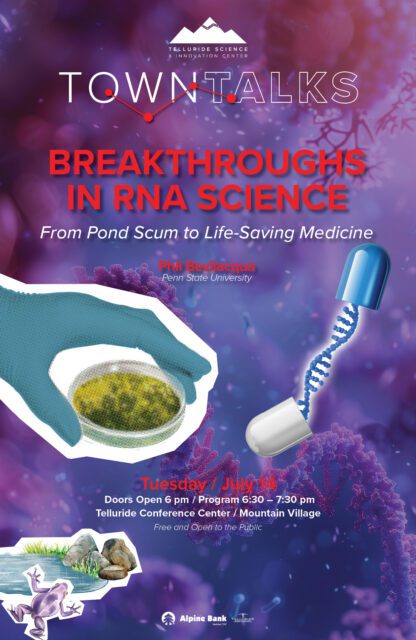
07 Jul Telluride Science Town Talk: “Breakthroughs in RNA Science: From Pond Scum to Life-Saving Medicine!,” 7/14!
This coming week the 2026 Telluride Science Town Talks series continues with “Breakthroughs in RNA Science: From Pond Scum to Life-Saving Medicine! The event features Dr. Philip Bevilacqua and takes place Tuesday, July 14. Doors 6 p.m.; talk, 6:30- 7:30 p.m.
Town Talks are FREE and open to the public.
Visit telluridescience.org to learn more about Telluride Science and the historic Telluride Depot, now the Telluride Science & Innovation Center. The venue is the permanent home for Telluride Science and a global hub of inspired knowledge exchange and development where great minds get to solve great challenges.
The 2026 Telluride Science Town Talks series is presented by Alpine Bank with additional support from the Telluride Mountain Village Owner’s Association.
Go here for more about Telluride Science.
Go here for more on Town Talks.
What if there were a cancer vaccine in the very near future?
If yes, it would be thanks to mRNA.
Most of us first heard about RNA during the COVID-19 pandemic. The molecule was key to the vaccines that saved 2.5 million lives.
Those miraculous vaccines were designed and manufactured in a short 42 days after the COVID genome was published – but decades of research by scientists like Dr. Philip Bevilacqua made that miracle possible.
COVID-19 was ground zero for the use of mRNA as a template scientists are using today to trigger some of the biggest breakthroughs in medicine against some of the most challenging afflictions.
At his Telluride Science Town Talk on July 14th, Bevilacqua will explain how basic RNA research has led to those breakthroughs with more to come.
In the run-up to his talk, a little background on mRNA.
mRNA is, as mentioned, a template and a messenger. We text our friends constantly. mRNA does the same thing with DNA all the time – exchange messages or genetic instructions from DNA that tell your cells exactly which proteins to make and when.
Scientists are learning to harness this natural messaging phenomenon to develop ways to treat, even prevent diseases that yes, include cancer, but vaccines against infectious diseases and more impactful gene therapies are also on the horizon.
Join Dr. Bevilacqua to discover how and in what exciting ways one tiny molecule is a powerhouse that can transform medicine now and into the future.
Dr. Phil Bevilacqua, more:
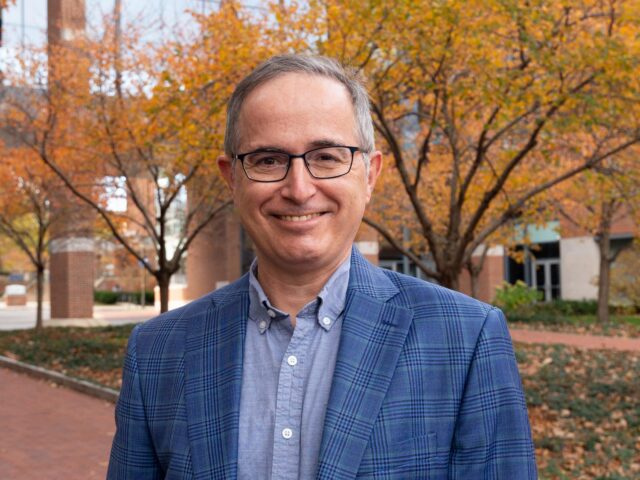
Dr. Bevilacqua is a distinguished professor of Chemistry, Biochemistry, and of Molecular Biology at Penn State University where he leads the Bevilacqua Lab.
His research focuses on how RNA folds into complex three-dimensional shapes and how those structures enable gene regulation, catalyze chemical reactions, and perform essential functions in cells under different conditions.
His lab develops new technologies to understand RNA’s role in disease treatment/prevention and the origins of life.
Bevilacqua earned his undergraduate degree in Chemistry from John Carroll University before completing his Ph.D. in Chemistry at the University of Rochester. During his postdoctoral research, he worked under Nobel laureate Dr. Thomas Cech at the University of Colorado Boulder where he studied how RNA’s structure gives it the ability to catalyze reactions. Bevilacqua’s postdoctoral work sparked his career dedicated to understanding RNA’s different functions in biology.
Caroline Simmons, more:

Caroline Simmons is from Austin, Texas, but has grown up spending as much time in Telluride as possible.
She is now a rising second-year at the University of Richmond, where she plays field hockey and is planning to focus on Biology and Health Studies.
Sorry, the comment form is closed at this time.