

24 Jun Telluride Science Town Talk: Tau: Shape-Shifting Protein & Early Detection Of Brain Disease!
This coming week the 2026 Telluride Science Town Talks series continues with “Tau: Shape-Shifting Protein That May Hold the Key to Early Detection of Brain Disease.” The event features Dr. Lukasz Joachimiak and takes place Tuesday, June 30. Doors 6 p.m.; talk, 6:30- 7:30 p.m.
Town Talks are FREE and open to the public.
Visit telluridescience.org to learn more about Telluride Science and the historic Telluride Depot, now the Telluride Science & Innovation Center. The venue is the permanent home for Telluride Science and a global hub of inspired knowledge exchange and development where great minds get to solve great challenges.
The 2026 Telluride Science Town Talks series is presented by Alpine Bank with additional support from the Telluride Mountain Village Owner’s Association.
Go here for more about Telluride Science.
Go here for more on Town Talks.
What comes to mind when you hear the word tangles?
Do you think of knots in your hair after a long day? The holiday lights in a heap in your garage? Vines weaving through a fence?
Bottom line: We spend time in our lives pulling things apart that were never meant to knot together. But some tangles resist our efforts, instead forming unhealthy knots inside the brain. Knots that might well be the most consequential of all.
When tau — a protein in brain cells that normally helps support their internal structure — forms such tangles, serious neurological issues result. In more than 25 brain diseases, including Alzheimer’s, tau can misfold and clump together into these harmful tangles. It remains unclear as to how the same protein can form such a wide variety of structures — for better or for worse.
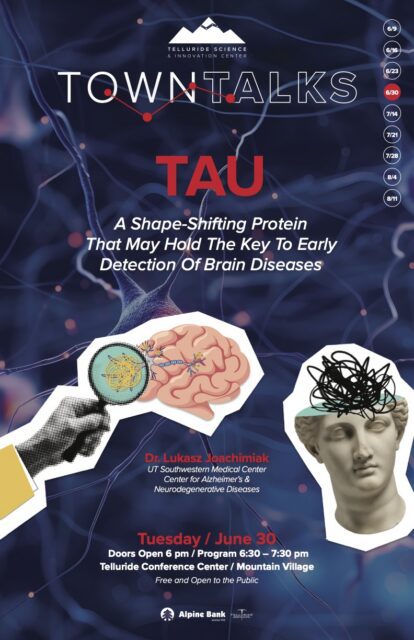
That question drives the work of Dr. Lukasz Joachimiak, who will speak at a Telluride Science Town Talk titled “Tau: Shape-Shifting Protein That May Hold the Key to Early Detection of Brain Disease.” The event takes place June 30 at the Telluride Conference Center in Mountain Village, 6:30 – 7:30 p.m.
Over the course of an hour, Dr. Joachimiak plans to examine the possibility of detecting specific forms of tau early and designing targeted treatments that can stop, even prevent, those diseases from occurring. Detection could be possible even as early as the teenage years.
To be able to spot Alzheimer’s evolving before a single memory is lost — and stop it in its tracks — would be nothing short of revolutionary. Fair to say the world would breathe a sigh of relief.
According to the Alzheimer’s Association, one in every nine adults in the U.S. will develop Alzheimer’s or other forms of dementia. That haunting statistic reveals just how widespread the impact of tau-related diseases really is. Research in this field would not only change the lives of those who might develop Alzheimer’s, but also those of families, friends, and caretakers forced to witness the quiet decline of someone they love.
Join Telluride Science to hear what Dr. Lukasz is doing to untangle the answer to some of society’s most daunting, frightening afflictions.
Dr. Lukasz, more:

Dr. Lukasz Joachimiak is an Associate Professor at UT Southwestern Medical Center in the Center for Alzheimer’s and Neurodegenerative Diseases, O’Donnell Brain Institute, Department of Biophysics, Department of Biochemistry. His research focuses on understanding how proteins misfold and form toxic aggregates in neurodegenerative diseases such as Alzheimer’s disease, frontotemporal dementia, ALS, and related disorders.
Dr. Lukasz’ laboratory studies tau and other amyloid-forming proteins that accumulate in the brain and contribute to nerve cell dysfunction and death.The research aims to enable new diagnostics and therapies for neurodegenerative disease by identifying early disease-causing protein conformations and developing ways to selectively target them.
Dr. Lukasz’ work bridges fundamental molecular science with translational approaches aimed at improving treatment options for patients suffering from currently incurable brain diseases.
Ava Yaley, more:

Ava Yaley is a rising second-year student at the University of Georgia studying Journalism and Marketing.
On campus, she is involved in Women in Media, Women in Business, Club Women’s Ice Hockey, and the Delta Gamma Sorority.
Originally from Littleton, Colorado, Ava graduated from Chatfield Senior High School in 2025.
She hopes to pursue a career in brand journalism.