

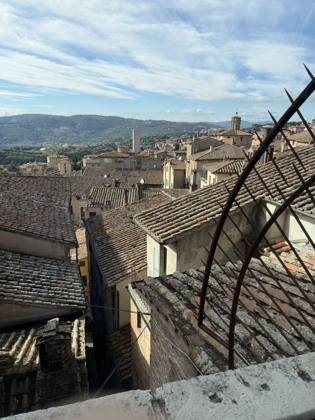
03 Nov TIO Italy: Fall-ing for Marche/Umbria!
Have iPhone, will travel. My partner, John Fitzpatrick, religiously took nearly all the images illustrating the following post about our recent road trip through Marche and Umbria. And I say “religiously” with tongue firmly planted in cheek. We found there was really only one through line written in Italian before the Risorgimento (or Unification, about 1861), a story sanctified in the architecture and fine art: Church (or Pope) v. State (or Dukes).
Neither region is curated for tourists so no attitude from the locals. Just the opposite: a manifest desire to help showed up in deeds, not just in words. One shining example happened Day 1. Hopelessly lost at our first stop, Ascoli Piceno, I got out of our car and asked a random jogger for the location of a certain landmark where the hotel manager was to meet us to bring us “home.” Instead of telling us where to go, the man got into the car and took us right to the spot. Yes, the road part of our trip was, to say the least, challenging. Then again, as the great travel writer Tim Cahill once told us in a Mountainfilm interview: “There is no story without something going wrong.” But the places we saw and the people we met, like that kind stranger, made all the gain worth the pain. And that stranger became an archetype for others we met from town to town: throughout our road trip, it was the faces that made the places. (We name names below.)
In the end, we will remain forever grateful that neither of us became roadkill, nor did we kill each other. And that our two-week adventure turned out to be all about Nature writ large, Mother and human, both resplendent.
And for that, we are grateful to our trip planner at SmartFlyer. (Scroll down for more on this service-driven company.)
And read on for the deeper details.
Heads, Skeletons and Mummies, Oh My!
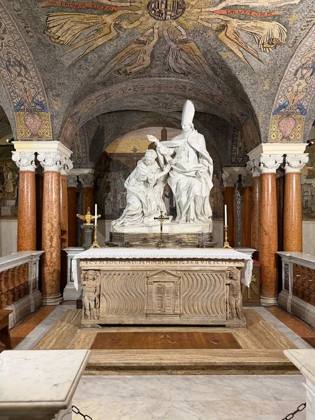
St. Emidio baptizing the Roman pagan princess. He lost his head over her.
On a walk on a lovely fall day in the hills near Ascoli Piceno in the year 309, you might encounter a saintly-looking man, head in hand – we mean literally – looking for a better place to rest his head – again, we mean literally. That would be Sant’Emidio, Ascoli’s first bishop and patron saint who, legend holds, was beheaded by the Romans because he dared to baptize the daughter of a pagan king. The little Tempietto di Sant’Emidio alle Grotte is where Emidio is now said to be resting.
In Foligno, a deconsecrated 18th-century church now houses the roughly 79-feet-long colossus known as “Calamita Cosmica” or “The Cosmic Magnet.”
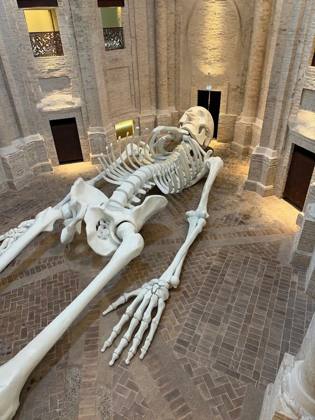
Cosmic Magnet, Foligno
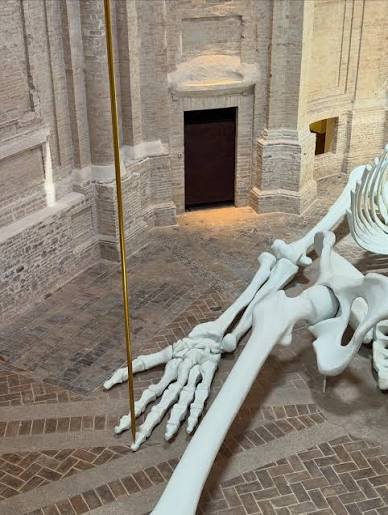
Cosmic Magnet, close up on the rod that give the work its name.
Conceived by the artist Gino De Dominicis, the skeleton with its beaked nose looks like an alien artifact dropped from outer space onto a traditional Italian piazza. The figure lies flat on the floor of a church, a place built with the promise life after death. A golden rod balanced on a fingertip, pointing straight up to the heavens, gives the Magnet its name. The joke is that something so huge and so dead can still hold a thing upright: hope. The long nose is apparently a recurring De Dominicis feature. He borrowed the proboscis from an ancient Mesopotamian myth, making it a signature motif rather than a cartoon-adjacent gag.
The irony of the Magnet? The artist is famously wary of having his work photographed. Now it is one of Umbria’s most Instagrammed objects.
We found the Magnet fun, funny, and curious. The thing is also widely considered a masterpiece of contemporary Italian art. Maybe, but isn’t there a bit of Emperor’s New Clothes in all the ballyhoo? For us, uh huh.
(On the subject of modern art, travelers will find some of the best at unexpected addresses, like the quietly elegant Villa Quiete in Montecassiano, near Macerata. More on that follows.)
Eighteen bodies, naturally mummified, stand upright in individual glass cases – peasants under glass? – in the aptly named Chiesa dei Morti, or Church of the Dead, in Urbania.
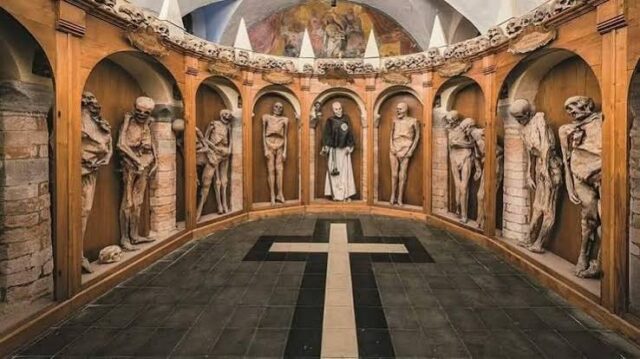
The mummies, Urbania (This is a courtesy shot from Facebook. No name. Cameras were not allowed.)
Local lore attaches an awful death to each body, including one poor soul allegedly who was buried alive – by mistake.
(Little known fact: Italian law today requires an observation period, usually 24 hours, before a coffin can be closed and a body buried, to make sure the once-living is now good and properly dead.)
Turns out Napoleon Bonaparte was responsible for the phenom, an indirect result of a public health decree issued in 1804 banning burials inside town walls.
Under the edict, Urbania had to clear out its old cemetery and move the dead outside of town. When the bodies were dug up, some had not decomposed. An organic quirk – a mold in the soil? its ph? the limestone? – had drawn the moisture out of the corpses and dried them naturally, so no embalming required.
Roads less traveled
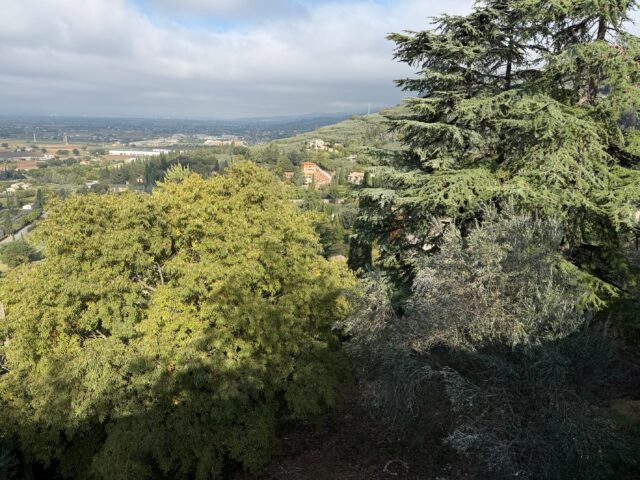
Yes, weird came with the itinerary. But Marche and Umbria offered up so much more: roads less traveled, lots to see and much to learn.
Places where fellow travelers are more likely to be Italians heading north to south (or reverse) or Germans (or so we were told at front desks along the way). We encountered very few other Americans.
Places where field work does not mean research. Field work means actually working the fields. In October that translates to the last of the grape harvest; the first olives coming off the trees for new-season oil; chestnuts dropping onto the ground of the woods nearby; tractors turning the fields over for winter.
And the grapes, of course, for the superior wines of the region, which we enjoyed daily.
What to order:
• In Marche: among the whites, Verdicchio, from the Castelli di Jesi or the hills of Matelica, and Pecorino and Passerina from the hills of Offida, near Ascoli. Among the reds, Rosso Conero and Rosso Piceno, both built on the Montepulciano grape, and the perfumed Lacrima di Morro d’Alba. Near Macerata, look for Vernaccia di Serrapetrona, a rare sparkling red.
• In Umbria: Sagrantino di Montefalco, one of Italy’s most tannic reds, and its sweet cousin, Sagrantino Passito. For whites, Grechetto and Orvieto Classico. For a classic red, Torgiano Rosso Riserva.
Carnivores, take note. Umbria is pork country – the town of Norcia gave Italy the word norcineria for a pork butcher’s shop – and porchetta, the herb-stuffed roast pig, turns up at markets and roadside vans.
Marche answers with ciauscolo, a soft salami spread on bread, with Prosciutto di Carpegna, and with beef from its white Marchigiana cattle.
Sadly, we missed the porchetta, though we did enjoy the prosciutto and the beef. Yes on the soft salami. Yes really on all the meats. But we were not fans of the much-vaunted olive all’ascolana, those big green olives stuffed with meat, breaded and fried. However the tomatoes, really all the produce – out of this world.
Chalk up this bounty – including the exotic bit, the regions’ “black stones” or truffles – to local weather which, despite a little rain at the get-go, stayed temperate from start to finish.
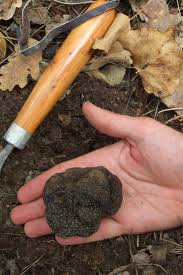
Black truffles, courtesy “Great Italian Chefs.”
Marche and Umbria boast perfect microclimates for truffles – humid river basins, limestone soils, and dense forests of oak and hazelnut – which make them rivals to Piedmont as Italy’s truffle capital from autumn through winter.
Traveling in early-to-mid October, we saw a kaleidoscope of greens as Umbria’s trees and flora in general were beginning to flash gold. In Marche, the iconic clay hills yielded a rich, earthy palette of greens, ochres, bright yellow, sienna and red. Lovely, too, to see how the silvery-green foliage of the olive trees stood out against the slowly turning vegetation.
Walk or drive through any town or village in October (or November) and it is impossible to miss the smells in the air: freshly lit stone hearths, damp earth, and the intoxicatingly musky aroma of shaved truffles wafting from kitchen vents.
Speaking of which…
Food, glorious food:
Locals told us only the Michelin-starred restaurants have a dress-up code, so we chose to skip them. No loss: the culinary landscape in this part of Italy is some of the most authentic, soulful and unpretentious in all of the country, shaped as it is by two distinct geographies. Umbria is entirely landlocked, so the focus is on deeply rustic forest-and-farm cooking; Marche runs from rugged mountains to the Adriatic Sea.
And frankly, despite a long and great list of restaurant recommendations from our very conscientious trip planner et al., at the end of long days of discovery and navigating the roads, we ate whenever it felt right and wherever locals sent us. Always very well, including at a few memorable meals at our hotels.
In Ascoli Piceno, Caffè Meletti, the Art Nouveau jewel on Piazza del Popolo, opened in 1907. Ernest Hemingway drank there. So did Jean-Paul Sartre. And King Victor Emmanuel III came twice for the house anise liqueur, Anisetta Meletti, and he made the café an official supplier to the Royal Household. In early October it was our turn. Coffee bean or no, not being fans of licorice, we enjoyed two perfect vodka martinis instead made table-side by a pro. People-watching, a local sport, was fun too after an afternoon on our feet touring.
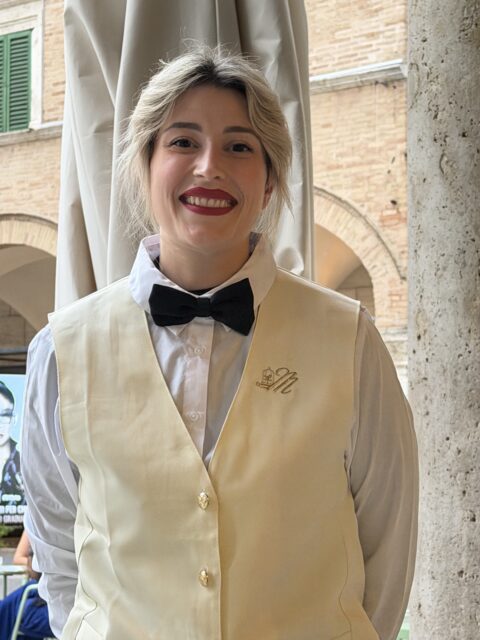
Our waitress Stephanie at the Cafe. Martini guy was in great demand. Had beat feet to another table.
At Ristorante Al Tartufo, Perugia’s premier venue for the fresh seasonal delicacy, guests like us get to enjoy truffle notes across the entire menu – martinis included. Turned out we were too early for the white variety. (Yes, definitely a first-world complaint.)
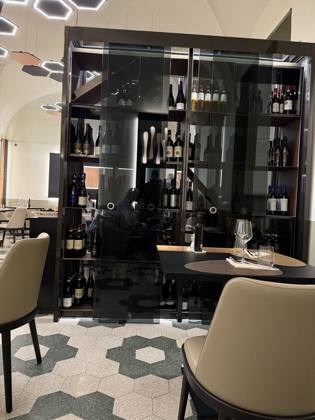
Ristorante Al Tartufo
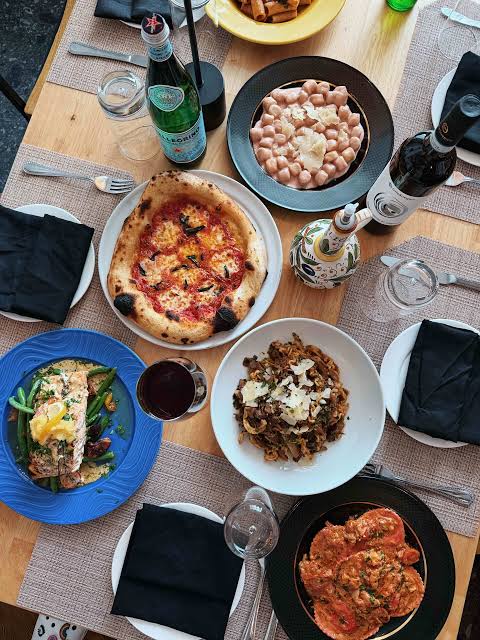
Image, courtesy Al Tartufo.
That said, the winner at the table was Arca, the independent restaurant inside our hotel in San Benedetto del Tronto. Beginning with a cold mushroom soup, moving on to the oyster stew (below), to the black cod, ending with a molten chocolate lava cake with berry ice cream, it was the most imaginative dinner of the trip. And that fact stands in the face of many years of visits to and lives actually lived in European cities noted for their cuisine. Don’t miss it.
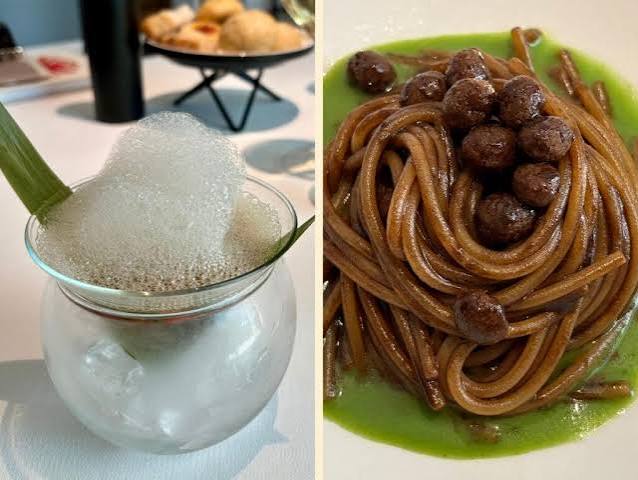
Image on the left is an oyster stew. Image, courtesy La Gazette del Gusto
When you go, say ciao to the hotel’s bartender Elia, and to Mattias, who waited on us, respectively at the hotel bar and in Arca. They are two of the reasons Smeraldo Suites & Spa is a four-star success.
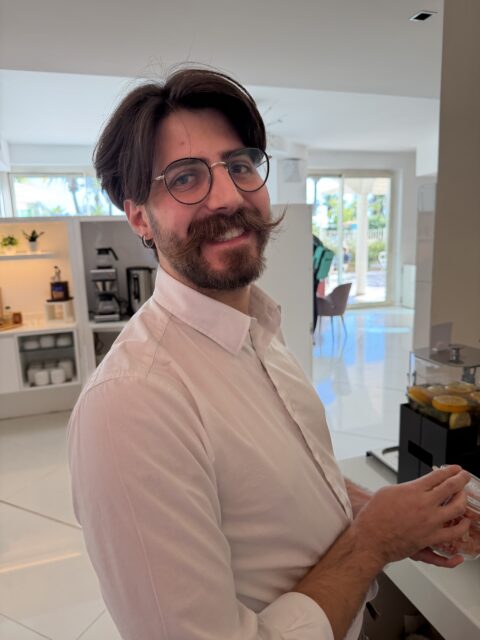
Elia. (Thick walls in Arca made it impossible to snap a shot of Mattias.)
In sharp contrast, our very last night on the road we wound up at the bar-restaurant of the airport Hilton, packed with polyester, message T-shirts and all manner of memorabilia on display in the crowd. Dinner turned out to be club sandwiches and fries. Oh well, can’t win them all.
Dress code and plenty of vertical:
The dress code in Marche and Umbria? Everyone remotely fashion-adjacent, especially the students in Perugia and Urbino, was tricked out in baggy or big, bold, black leather jackets; jeans, mostly baggy, or skirts; and chunky sneakers – generally white, but really any and all varietals.
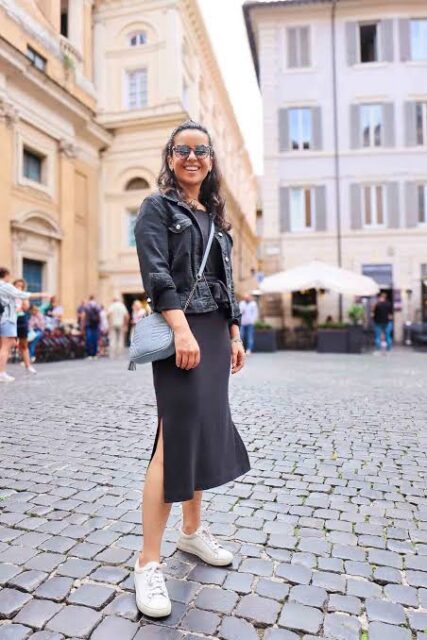
What to wear in Italy in October. Courtesy,” ways of style.”
The footwear of choice – for students, other locals and the few tourists we encountered – made sense given all the uphill climbs on bumpy streets you will be doing if you follow in our footsteps. Leave your Jimmy Choos and Manolos at home, unless, of course, you want to use the travel insurance you bought, but never thought you would use, to pay for a sprained ankle – or worse.
Summing up? KISS (Keep It Simple, Stupid). No one in this part of the world seemed to give a damn what anyone else was wearing – in sharp contrast, as we recall, to Rome, Florence or Milan. So pack light. The trunk of the small rental you will be driving only holds so much.
And Type As, fear not: you will get your aerobics. As stated, there is plenty of vertical to conquer on a survey trip to hill towns.
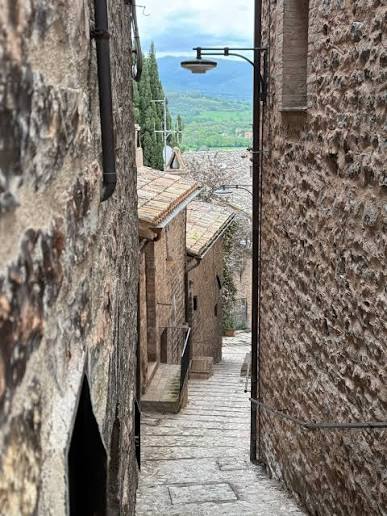
Climbing Spello
One example among many: Spello, a stop on our way to somewhere else. The ancient toy town is said to hide several ultra-modern art galleries behind its Roman stone facades – with contemporary projects showing experimental sculpture alongside local Umbrian landscapes.
The hike to the top of towns like this is not for the faint of heart – or lungs. Yet we witnessed a few enterprising young (or not so much) ladies in high heels and miniskirts making the trek up the cobblestones for the expansive views. Their “canes” were their hapless escorts.
If they made it, Ripley’s should take note.
Long and winding roads
Caveat emptor. A survey trip requires a steady hand at the wheel and nerves of steel on the long and winding roads that pass through a seemingly endless network of tunnels.
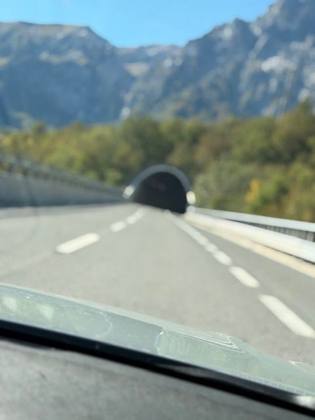
Entering a tunnel near Gran Sasso
Those tunnels are infrastructure with deep roots. In 76 AD, the story goes, the emperor Vespasian cut the Furlo tunnel on the Via Flaminia. We can still drive through that one.
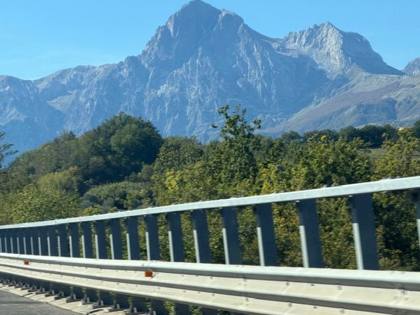
Gran Sasso from the highway
These tunnels are also a necessity because the Apennine Mountains form a jagged spine that runs directly through the regions on our radar. To connect the west coast of Italy (Rome and Tuscany) with the east coast (Marche and the Adriatic), engineers simply had no choice but to bore through solid limestone rather than wind endlessly over treacherous peaks. (Pioneers crossing the US under the spell of Manifest Destiny never got that memo.)
Woodpeckers, popes and dukes, a short history of the region:
The history of Marche and Umbria pre-dates Rome and underlines the nonstop power struggle between Church and State.
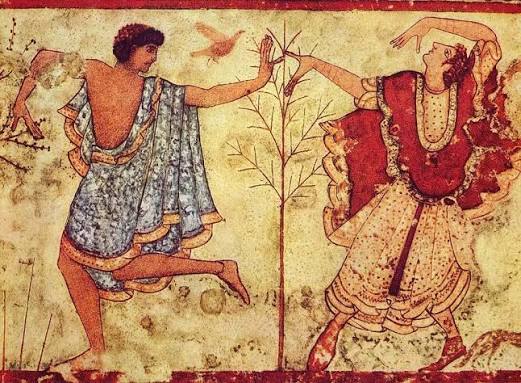
Image, courtesy Weird Italy.
People have lived in these hills since the Stone Age. Proof can be found in the museum in Recanati, which shows a Neolithic village dating back to 6000 BC, some 8,000 years ago. But the story we all can still see as tourists begins about 3,000 years ago with the Picenes, who gave Ascoli Piceno its name.
The Picenes came with a founding legend worthy of Disney.
According to Roman lore, the Sabines, a mountain people northeast of Rome, practiced a ver sacrum or “sacred spring”: in hard times they dedicated a generation of their young people to Mars, the god of war, and sent them off to find new lands. One band supposedly followed a woodpecker or picus – Mars’s sacred bird – over the Apennines to the Adriatic side and settled there. Hence Piceni. The woodpecker is still on the Marche’s regional emblem.

Green woodpecker, avatar of Mars, image courtesy Wiki.
Their neighbors were the Umbri and the Etruscans, who built Perugia. Rome swallowed them all and, in 220 BC, laid the Via Flaminia to the Adriatic, the road we kept rediscovering – not always because we were meant to be there.
From 756 until 1860 these regions mostly belonged to the Papal States, and their history is that long tug-of-war between the Church, which claimed the land, and the towns and warlord dukes who actually ran them. Ascoli Piceno underlines that point by putting both sides on one square: on the town’s travertine Piazza del Popolo, the Palazzo dei Capitani del Popolo, seat of civic power, and the Gothic church of San Francesco, have kept an eye on each other for seven centuries.
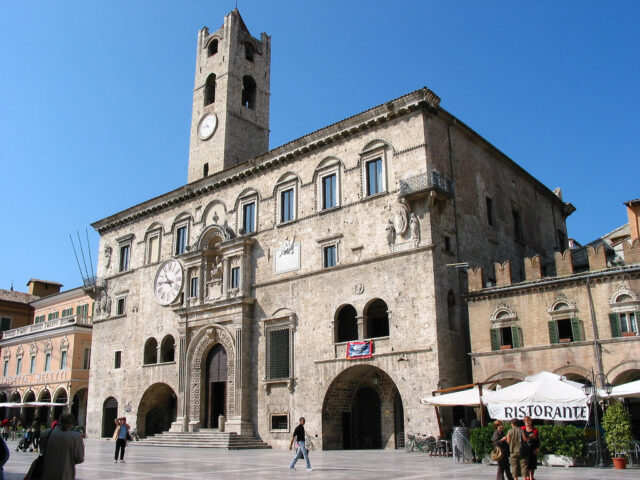
Church and State share the town’s “living room.” Courtesy Wikimedia Commons.
Perugia rebelled against Pope Paul III over a salt tax in 1540 and lost. The pope buried the ruling Baglioni family’s neighborhood under a fortress, the Rocca Paolina. Tourists are invited to walk the medieval streets entombed beneath it, which we dutifully did, but found the stop more meh than great. We did not linger.
Urbino showed a different response to papal power. Federico da Montefeltro, a mercenary general who fought for and against popes, spent his fees on the Palazzo Ducale – less a castle than a small city in the form of a palace. And he made Urbino one of the great courts of the Renaissance.
(Raphael, for one shining example, was born in Urbino in 1483. He is the artist who managed to absorb the psychological depth and sfumato (soft shading) of Leonardo da Vinci, as well as the dynamic human forms and muscular power of Michelangelo. Raphael’s alchemy transformed those titanic influences into his own beautifully balanced style featuring symmetry, ideal beauty, and technical grace. Examples below.)
In the end, however, the Church outlasted the dukes. In 1631, Urbino passed to the pope.
The deal was Popes and bishops paid for altarpieces meant to instruct and impress the faithful. Dukes and city guilds paid for art that flattered them. Perugia’s money-changers’ guild, for example, hired Perugino to fresco its meeting hall, the Collegio del Cambio, around 1500. The artist wound up painting pagan sages and heroes of antiquity right alongside the prophets, a self-portrait thrown in for good measure. In Urbino, Federico da Montefeltro lined his studiolo with portraits of great thinkers – and of himself. (Check out examples under Perugia and Urbino, also below.)
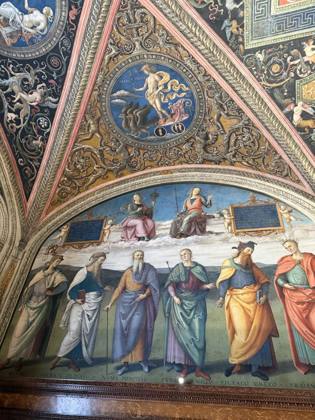
Sala delle Udienze in Collegio del Cambio, Perugino’s prophets and Sibyls.
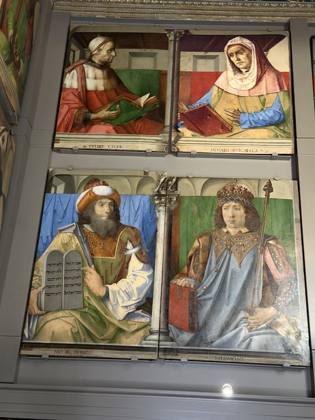
Studiolo portraits
Art, fine or not so fine, showed up everywhere on our itinerary. We found what we felt was the best of the best in Perugia and Urbino. There was art of note in Ascoli Piceno and Loreto, too, likely at every stop, but we only had so much time. The contemporary scene plays hide-and-seek in small hill towns and on hotel walls, such as those of the Villa Quiete.
Where did we go and what more did we see?
Highlights follow, in order of appearance.
Stop by stop:
SmartFlyer’s itinerary outlined a self-drive loop that ran 11 nights, out of Rome and back, with the trip planner outdoing herself in the choice of guides and hotels: all hits, no errors.
Ascoli Piceno: Palazzo Guiderocchi (2 nights):
Palazzo Guiderocchi was our first stop. We finally made it there after a way too long drive from Rome to Orvieto to Ascoli Piceno – though actually finding the place required an intervention by the hotel manager, aided and abetted by the very kind jogger mentioned in the intro. Alessio met his weary travelers and guests with big smiles, so again, from the get-go we were twice blessed with the leitmotif of the trip firmly established: open arms and help wherever and whenever help was needed.
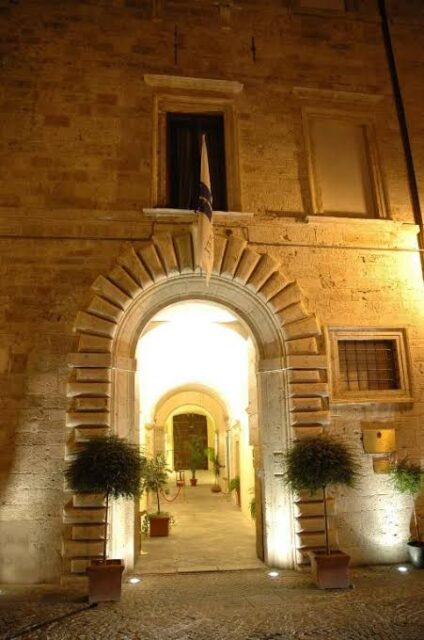
Palazzo Guiderocchi, courtesy Books.com
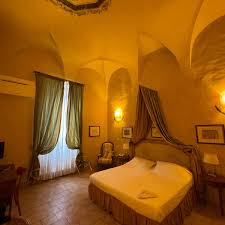
Our room at the Palazzo
Our 16th-century hotel sits a few steps from Piazza del Popolo and a number of restaurants, including the aforementioned Caffè Meletti. It sports original coffered ceilings, terracotta floors and an ancient cellar where local wines are poured.
Parking in the courtyard was a gift in a town where parking is otherwise a rumor – a challenge that turned out to be true at all of our stops. So, make sure your trip advisor has a shot of the license plate on your rental to send to all the hotels.
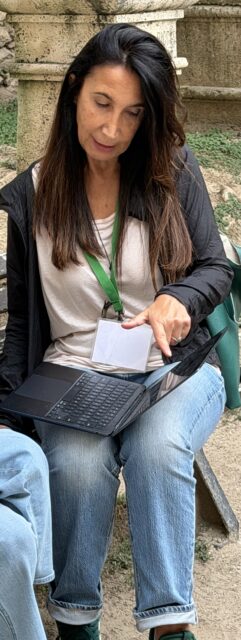
Lella, our guide in Ascoli Piceno.
As we learned from Lella, the first of our four exceptional tour guides, Ascoli is built almost entirely of travertine, the pale local stone that makes the whole town seem to glow at dusk, the hour of la passeggiata – literally “the stroll,” though in practice that generally translates to what we did – people-watching.
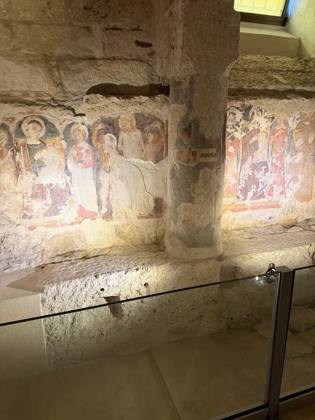
Early frescos, crypt, St. Emidio.
The Cathedral of Sant’Emidio on Piazza Arringo was built atop a pagan temple to Juno. In its crypt, a marble sculpture shows Emidio baptizing that pagan princess, (pictured above), while upstairs hangs Carlo Crivelli’s gilded polyptych of 1473, all jewels, fruit and anxious, wiry saints.
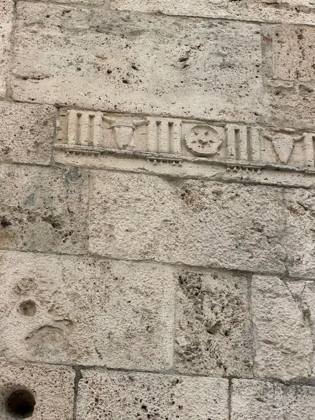
A Roman frieze of sacrificial ox skulls and rosettes, recycled into a later wall – Ascoli’s layer cake sliced open.
Ascoli apparently recycled like crazy, epsecially Roman stone. Medieval builders took blocks from ruined Roman buildings and set them into new walls, sometimes keeping the decoration on display.
Piazza del Popolo, “the city’s living room,” as Lella described it, is one of the most elegant squares in Italy, where every summer the Quintana, a medieval joust, fills the town with knights and banners.
(Note: That event is a cousin to Siena’s Palio. Both are civic contests with medieval roots between a city’s rival neighborhoods. Both come with costumed historical parades, flag-throwers and drums, both happen in summer. And in both, neighborhood pride runs fierce all year round. The key difference: the Palio is a horse race; the Quintana, a joust.)
Lella opened our tour by waxing metaphoric, describing Ascoli Piceno as a cake with many layers – Picene, Roman, medieval, Renaissance, modern. When that cake ultimately got cut, the layers mashed together. That helps explain why we found Ascoli very rich in culture, but not especially easy on the eyes.
Foligno: Relais Metelli (1 night):
Next up, Relais Metelli, just 11 rooms in an historic building a short walk from the cathedral and the “Calamita Cosmica.” The place sports antique furnishings, a garden of palms, and a bar with a serious cocktail list.
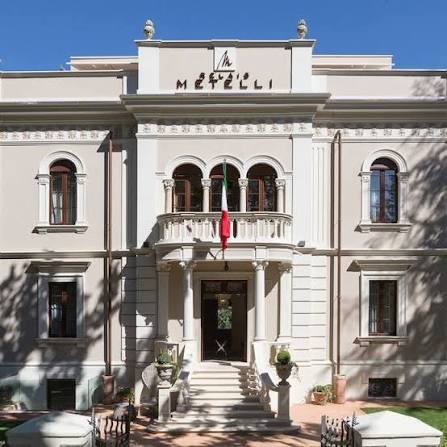
Relais Metelli
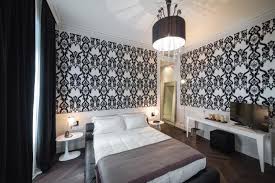
Our room at Relais Metelli.
Unlike its hill-town neighbors, Foligno sits flat on the plain. Locals have long described their town as “lu centru de lu munnu,” the center of the world.
The nickname, however, has nothing to do with the plain. But Foligno does actually sit near the geographic middle of Italy, at an old crossroads where the Via Flaminia and the routes over the Apennines meet. Today the locale still functions as a rail and road junction. And locals turned that into a point of civic pride and a bit of a running joke.
Foligno also has a claim to literary fame: in 1472, Johann Numeister, a German printer from Gutenberg’s circle, printed the first edition of Dante’s “Divine Comedy” there.
Architecturally, the town is Romanesque at heart, but with an obvious 19th-century neoclassical makeover. The likely reason? A strong quake hit Foligno in 1832 and damaged much of the center.
Quakes continue to be a thing in this part of the world. Italy’s earthquakes and volcanoes can feed Vesuvius, Etna and Stromboli, so there is plenty of fire, just not due to the infamous Ring of Fire. Quakes mostly come from the African plate pushing north into the Eurasian plate. That squeeze raised the Apennines and is still at work, which is why central Italy shakes so often, as in the 2016 quakes that badly rocked Tolentino. We stopped in that town, which remains under repair 1o years later. We were told the Church decides who, how much and when, but has apparently been dragging its blessed feet.
Following the restoration, bits and pieces of Foligno morphed into neoclassical gems, all columns, clean classical lines and calming symmetry. Examples are the town hall and Palazzo Trinci, both of which got new fronts, while older Romanesque and Gothic work survived behind them and in buildings like the cathedral. But the bones of the town are medieval. And Foligno is a working town, with a rail junction that was heavily bombed in World War II and shaken again by the 1997 earthquake. So the town feels real, not pasteurized for public consumption.
Which is why it was such a surprise to find Palazzo Trinci’s frescoes and the “Cosmic Magnet” at this particular address on our route.
We’ve discussed the Magnet at length, now on to the Trinci clan.
For 134 years the Trincis ran Foligno and, like every ambitious clan in those hills, they built a palace to underline that fact. Finished in the early 1400s, Palazzo Trinci is a power statement painted floor to floor. The family hired Gentile da Fabriano, the most fashionable painter of the day for the job, along with a crew of other local masters to cover the walls with fantastic frescoes of heroes, planets and the liberal arts.
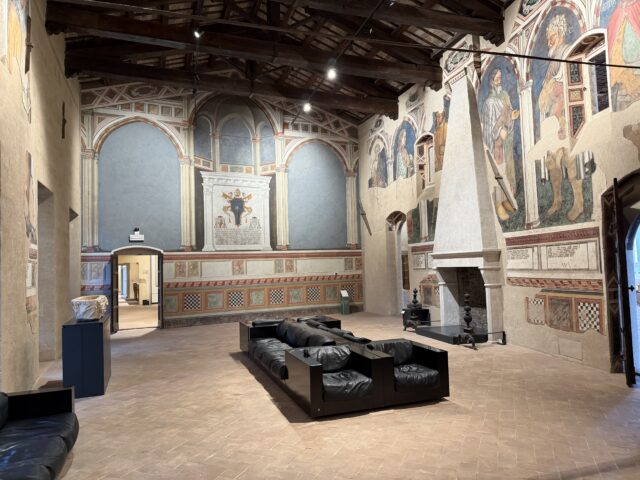
A gallery in the Palazzo Trinci.
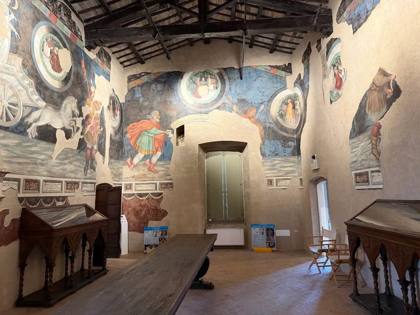
Frescos, Palazzo Trinci, Foligno
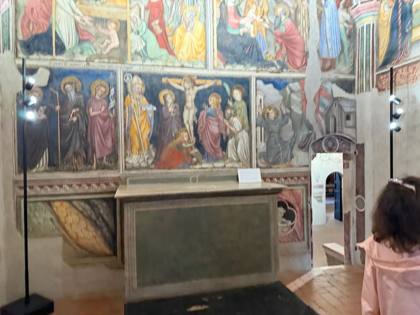
More frescoes from Trinci.
In 1424, one Ottaviano Nelli filled the private Trinci chapel with the life of the Virgin, in jewel-box blues and golds. It is among the best-preserved painted interiors of 15th-century Italy.
The punchline of our Foligno stop is pure Marche-Umbria: after raiding the family’s piggybank to trick out their palace, in 1439 the pope’s men took Foligno.
The Trinci were finished.
Church beats dukes. Again.
Perugia: Sina Brufani (1 night):
Open since 1884 on Piazza Italia, at the head of the main drag, Corso Vannucci, Sina Brufani is Perugia’s grande dame, and the only five-star hotel in the historic center. Downstairs in the spa, under medieval vaults, the foundations of an Etruscan settlement glow behind glass. Up top, the roof terrace looks out over Umbria. Throughout, the service was warm and welcoming, and the restaurant on site served delicious, very fresh food at a late lunch and even later snack.
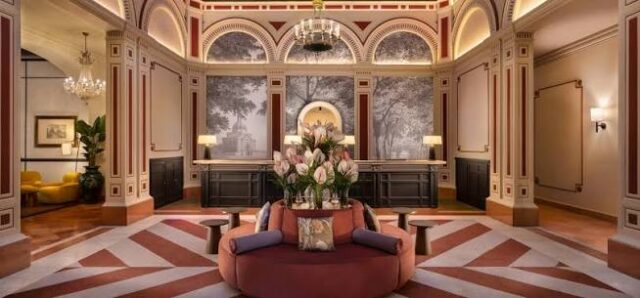
Historic Siina Brufani, Perugia, courtesy the hotel.
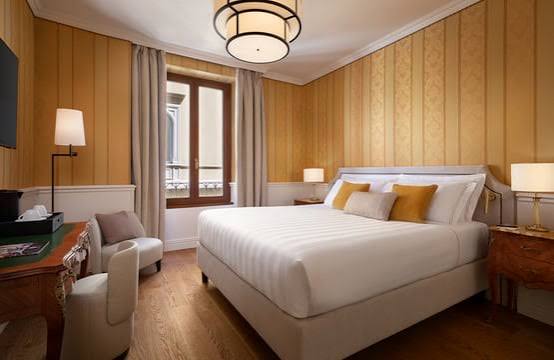
Our room at Sina Brufani.
Perugia began as an Etruscan city, and its massive Etruscan Arch still serves as a city gate. The main drag, Corso Vannucci, is named for the painter Perugino, born Pietro Vannucci. The town runs to Piazza IV Novembre, where the Fontana Maggiore, carved by Nicola and Giovanni Pisano in the 1270s, stands between the town hall and the cathedral.
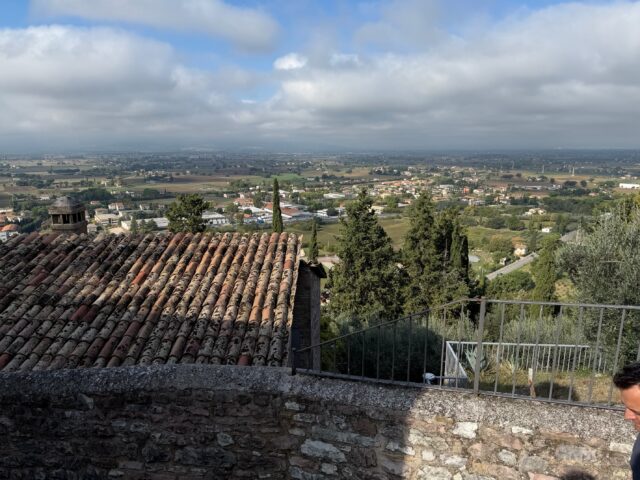
Rooftops, Perugia. Tiles like these are ubiquitous in Marche/Umbria.
Perugia also gave the world Baci chocolates, from the Perugina company, founded in 1907; every year the town plays host to the Umbria Jazz. A country-wide chocolate fair filled the main square while we were there.
Perugia is also one of Italy’s great student towns.
About 25,000 students attend the University of Perugia, founded in 1308. And the University for Foreigners adds thousands more who come to learn Italian, so the vibe on Corso Vannucci every evening is energetic, international, and trendy – also smoke- and vape-filled.
The art scene? The Galleria Nazionale dell’Umbria, in the Palazzo dei Priori, holds the world’s richest collection of Perugino, Raphael’s teacher, who also pioneered the compositional clarity, symmetrical perspective and graceful forms that later defined the High Renaissance.
In the Galleria Perugino’s work shows alongside other masters such as Fra Angelico, Piero della Francesca, Titian and more. Next door, the must-see Collegio del Cambio frescoes glow in the very room where Perugino painted them for local money changers.
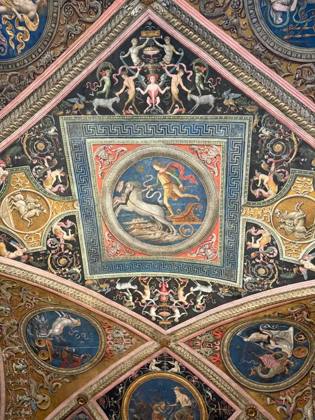
Vault with planetary gods, Collegio.
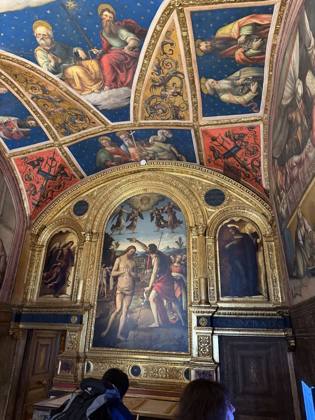
Transfiguration and Nativity walls, visitor is for scale in Perugino’s Collegio.
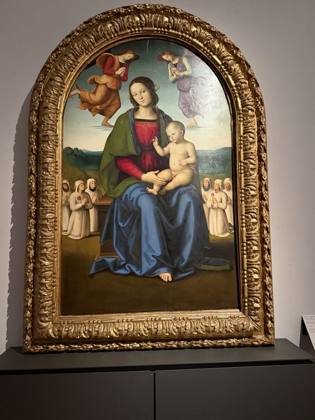
Madonna and Child, Perugino room in Palazzo Ducale.
Urbino: Hotel Mamiani (3 nights):
Mamiani is a modern hotel with a small spa just outside the walls, a few minutes by car from the Ducal Palace, which made it a practical base in a town whose old center is closed to cars. The walls are covered with glittering Pop images of American movie stars and singers, all of them women, among them Marilyn Monroe, Elizabeth Taylor and Cyndi Lauper. However, the staff was clueless about the who, when or why of the collection.
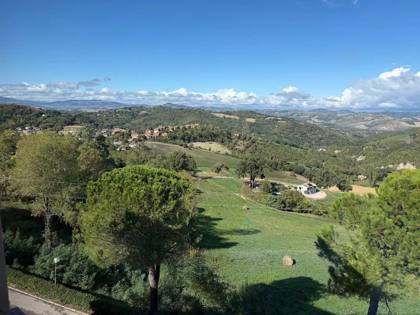
View from our top floor window at Hotel Mamiani.
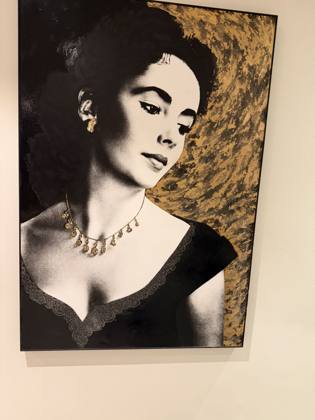
Likely Elizabeth Taylor, Hoel Mamiani.
In Urbino, as our guide Leonardo explained, students actually outnumber locals: about 14,500 attend the University of Urbino Carlo Bo, founded in 1506, in a town of fewer than 14,000 residents. Curious travelers routinely see professors holding class outdoors in the piazzas, in the parks, or in front of the Ducal Palace.
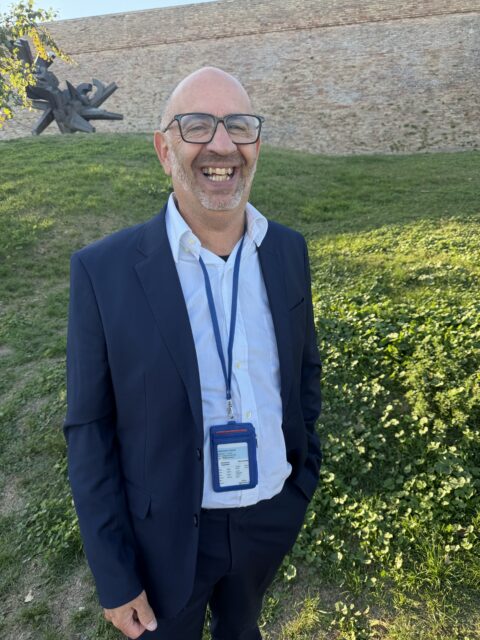
Leonardo, our guide in Urbino. Image taken at the fort at the tippy top of town.
Leonardo marched us straight up a cobblestone hill to the little Oratorio di San Giovanni Battista, frescoed by the Salimbeni brothers in 1416 with scenes so lively they almost talk, then past Raphael’s birthplace and the monument the citizens built in his honor. Our destination was Fortezza Albornoz, a 14th-century fortress way above town, inside the Parco della Resistenza. Don’t miss the stories of the prisoners locked inside and the panoramic views across Urbino to the Ducal Palace’s twin towers.
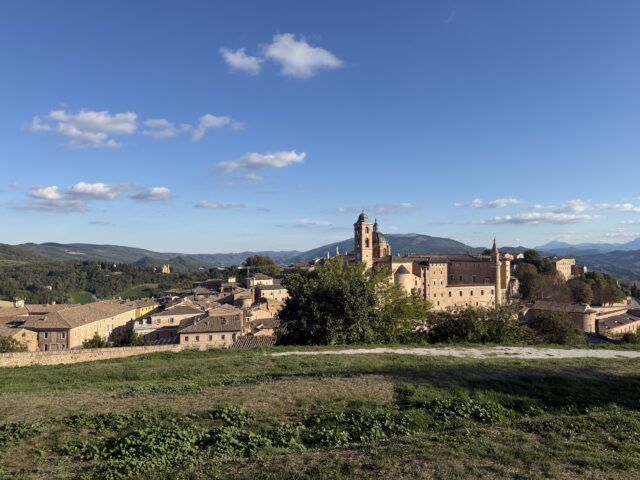
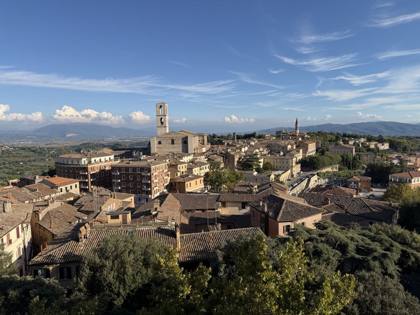
Another view from the top of Urbino.
The art: the Galleria Nazionale delle Marche inside the Palazzo Ducale holds Piero della Francesca’s enigmatic “Flagellation of Christ” and Raphael’s “La Muta,” a portrait of a woman who says nothing, yet is. said to tell all. The artist’s birthplace is a short walk uphill, but the address is mostly just a house minus Raphael’s art, so we passed.
But oh my, back at the Palazzo.
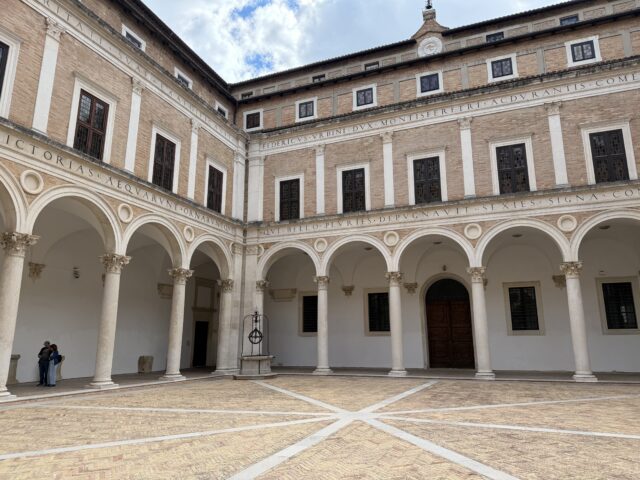
Ducal Palace, Urbino
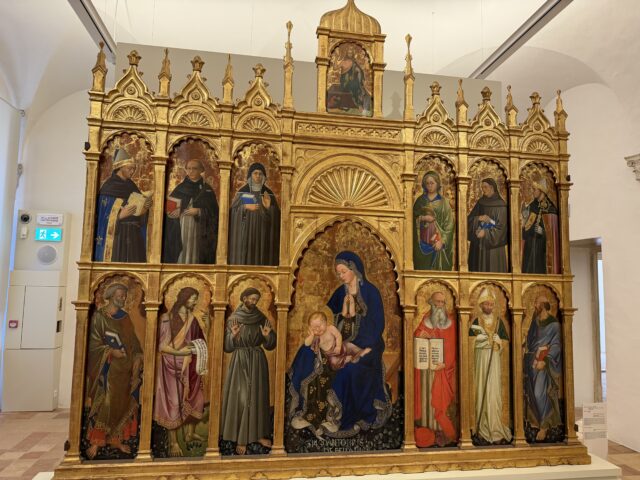
This big gold altarpiece is by Antonio Alberti da Ferrara, “Polyptych of San Donato,” 1439. He was the leading painter in Urbino just before Federico da Montefeltro remade the town. This image is late Gothic: gold ground, pinnacles, saints in separate niches.
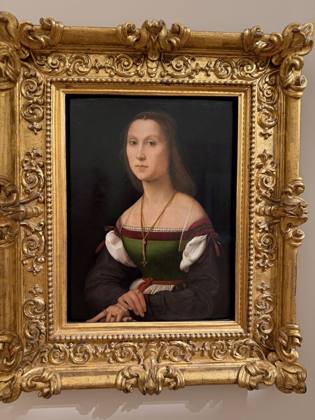
Raphael’s ‘La Muta.”c. 1507. Little known factoid: the painting was stolen from the palace in 1975, along with two other art treasures – Piero’s “Flagellation” and “Madonna di Senigallia.“All three were recovered in Switzerland the following year.
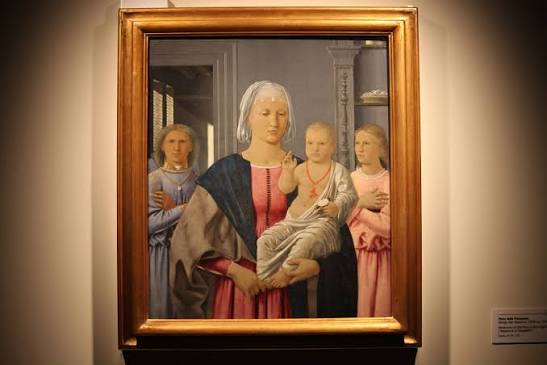
Piero della Francesca, “Madonna di Senigallia,” c. 1474. A painter-mathematician, the artist wrote treatises on perspective and geometry. His figures sit in measured space and a still, cool light.
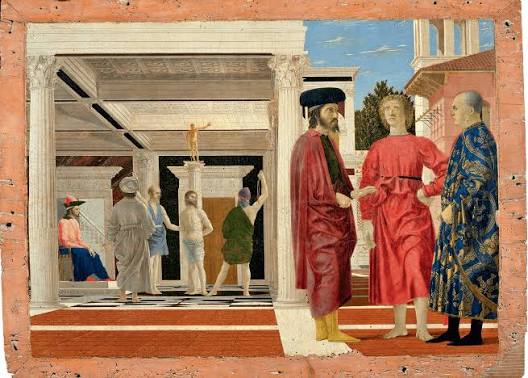
Art historian Kenneth Clark considered Piero della Francesca’s “Flagellation of Christ” the “best small painting in the world.” The greatest debate surrounding the work is the identity of the three figures on the right, who appear entirely indifferent to the torture of Christ happening in the background.
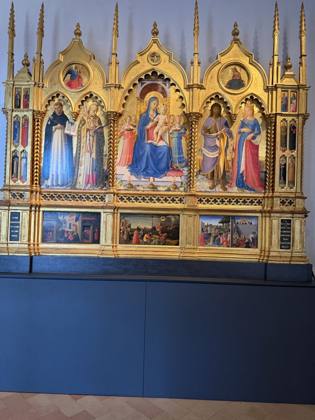
Fra Angelico’s Guidalotti Polyptych.
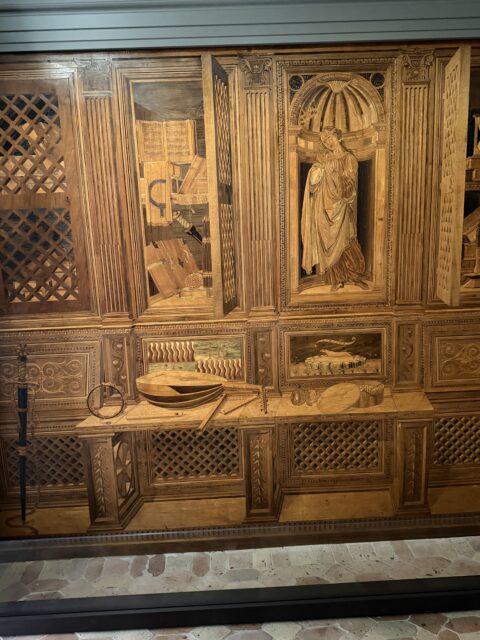
Scenes in carved wood of Studiolo
Four of the “Famous Men” (Uomini Illustri) from Federico da Montefeltro’s studiolo, painted around 1473–1476 by Justus of Ghent,
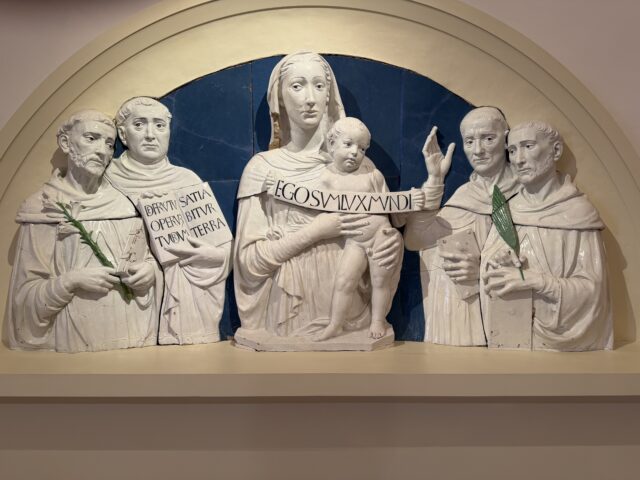
White-and-blue lunette is by Luca della Robbia, “Madonna and Child with Dominican Saints,” c. 1449–51. Saints are Dominic with the lily; Thomas Aquinas with the open book; and, on the right, Albert the Great and Peter Martyr with his palm. The Christ Child’s scroll reads “Ego sum lux mundi” or “I am the light of the world.”
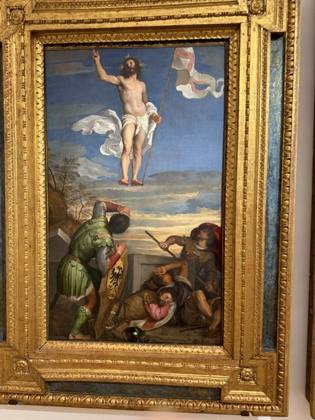
Titian, “The Resurrection.” The artist was the giant of Venetian painting. He built pictures out of color and loose, visible brushwork rather than making images by drawing lines.
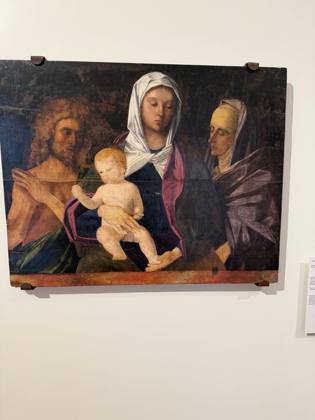
Giovanni Bellini, “Madonna and Child with Saint John the Baptist and Saint Anne.” Baptist in his rough garment on the left; Anne, Mary’s mother, in her veil and head covering on the right.
Why the early Renaissance wins our hearts, and Mannerism misses the mark:
The story starts with the painters of the Trecento, the 1300s, most notably Giotto, the forerunner, who was among the first to paint real bodies with real weight and feelings. Giotto is often described as the “Father of the Renaissance,” but the Renaissance proper came about a century later.
It was a time when painters were still discovering how to show the world with its weight and gravity; how to build real space with perspective; how light falls on a wall; what a real face looks like when an artist manages to capture his subject’s soul.
The Quattrocento, the 1400s, belongs to the artists who built on Giotto’s lessons: painters Masaccio, Fra Angelico, Piero della Francesca, Botticelli and Perugino, all among our favorites in Perugia and Urbino. In architecture and sculpture, the pace makers were Brunelleschi and Donatello.
Again, Piero’s figures stand in a clear, still light the intensity of which we could almost measure. Raphael’s “La Muta” looks back at us as a person, complex, thoughtful, and definitely not some archetype.
This is art about life, made by painters who experimented with beauty as truth.
Mannerism, on the other hand, is art about art.
By the 1520s, many mark-makers believed Raphael and Michelangelo had solved painting once and for all, so they turned to style for style’s sake: weightless saints with upturned eyes, elongated necks, twisting poses no real body could ever hold, rendered in sour pinks and acid greens.
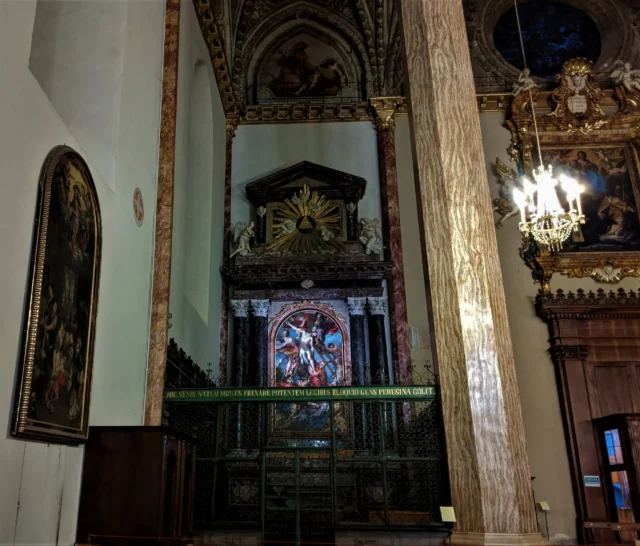
Federico Barocci’s Deposition (1569) in the Chapel of San Bernardino, Perugia Cathedral. Barocci was from Urbino, which ties the two big art towns together neatly.
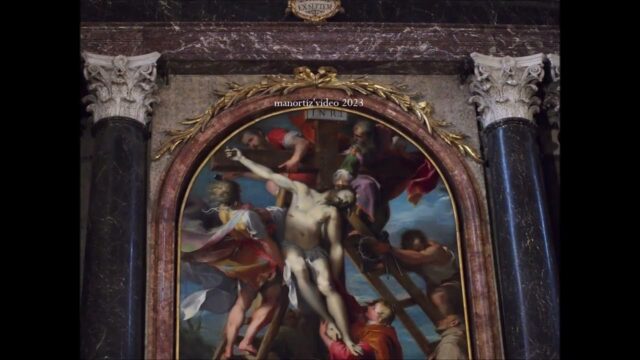
“Deposition” close up. Note how bodies twist and strain, Christ’s pale torso slides diagonally down the ladder and colors run to the rosy pinks and acid yellows we described. Barocci himself is usually described as late-Mannerist or proto-Baroque, though. He is considered the master provincial copyists were imitating. Barocci is the source of the style rather than the “copy of a copy” we reference with regard to even sadder work on display in provinces like Urbania.
A clear degradation of Renaissance beauty, no? It did not help the case for Mannerism to see those pieces in Urbania’s provincial museum just a day or so after admiring “Flagellation” and “La Muta.”
But the story gets worse. The images that actually reached the provinces were copies of copies – workshop painters imitating Barocci, who was imitating Raphael – all under the Council of Trent’s post-1563 rules that religious art be clear, decorous and safe.
We find an apt analogy in nonna’s kitchen.
The Quattrocento is the grandmother perfecting her ragù by taste, Sunday after Sunday, every pot and pan, a discovery impossible to resist.
The High Renaissance is the Sunday her meal comes out perfect. Nothing to be added; nothing to be taken away.
Mannerism is the chef who deconstructs it into foam on a slate. Technically interesting, but we leave hungry.
Summing up, Mannerism began as what was seen as a genuine crisis centering on what and how to create after the bounty of Renaissance beauty. Especially in the provinces, the response ended up as sugar.
Macerata: Villa Quiete, Montecassiano, Villa Quiete, a Hunting Lodge That Became a Gallery (2 nights):
Our base for Macerata, and for a major day trip to Loreto, was Villa Quiete.
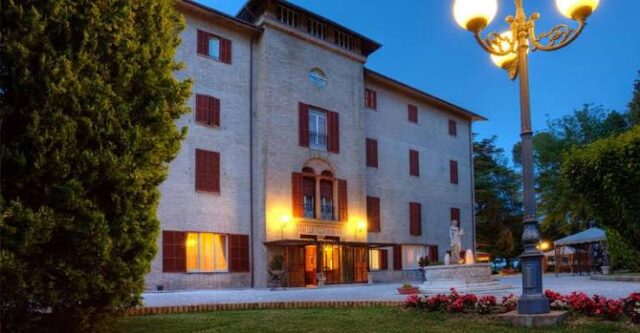
Villa Quiete, courtesy the hotel.
Our new besties – the hotel manager and our concierge Ilaria – recounted the history of the place.
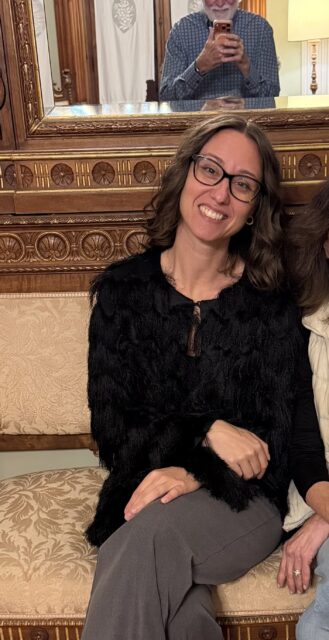
Ilaria, our concierge at Villa Quiete. Charming, smart, indispensable. (Notice the photographer reflected in the mirror.)
Villa Quiete, a late-18th-century villa, sits in parkland below the hill town of Montecassiano, about 10 minutes from Macerata. From the driveway the look of the place was almost severe: a tall, pale block of a house with oxblood shutters, a fountain and statue out front; old trees stand guard. That plainness is a clue to the Villa’s past. The nobleman Domenico Perozzi built the lodge not as a showplace, rather as a gentleman’s retreat, a gathering point and refreshment stop for hunting parties working the surrounding hills.
Step inside and the house changes character.
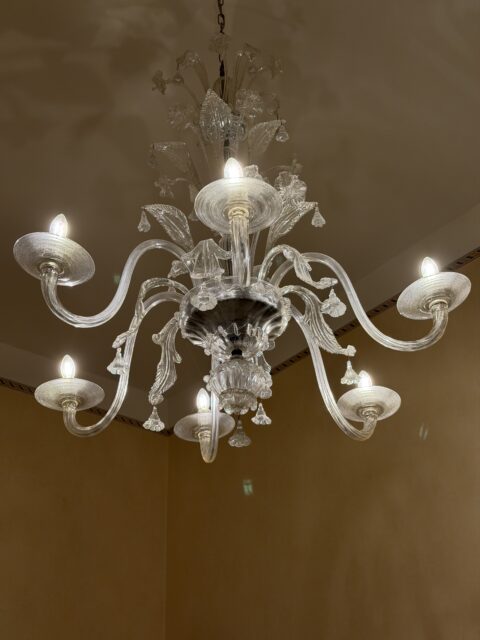
The décor follows the old aristocratic script: burl-walnut sideboards, marble-topped consoles, gilt mirrors, Murano chandeliers dripping glass leaves and flowers. But the walls are hung with work that belongs nowhere near a hunting lodge.
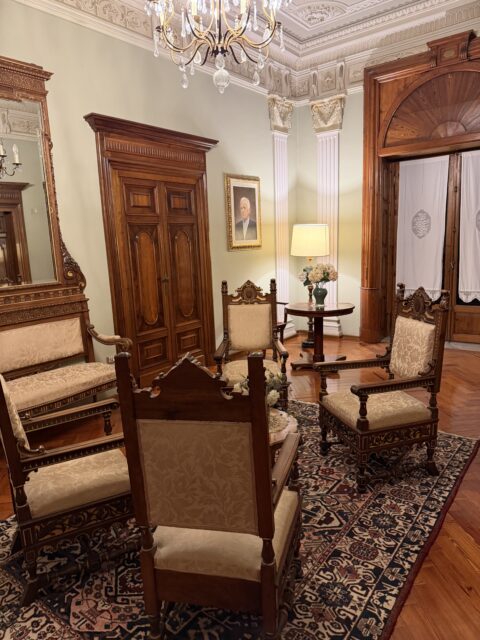
Count & Countesses’ original digs on Quiete’s first floor.
Philippe Artias was a Frenchman, born in the Loire in 1912. He fought in the Resistance, then gave himself entirely to painting after the Liberation.
In the early 1950s Artias worked alongside Picasso at Vallauris, an influence visible in the canvases on the walls of Quiete’s quietly elegant dining room.
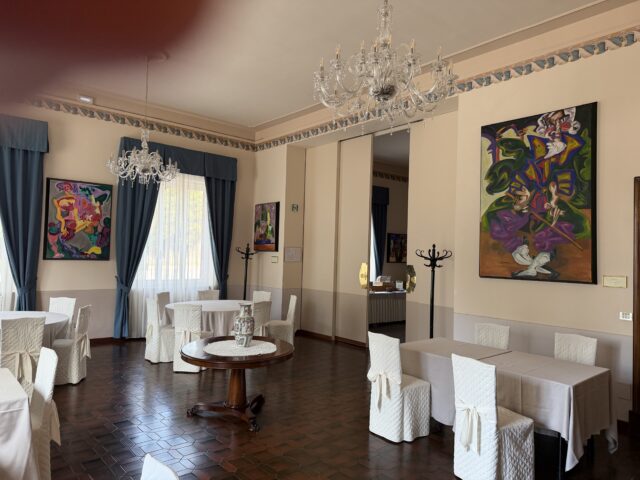
The stark backdrop of the dining room works as the perfect blank canvas to showcase Artias’s lively art.
In one of Artias’ paintings, a harlequin-like figure is broken into planes of green and violet. Over a walnut sideboard carved with brooding wooden telamons, a street crowd in Fauvist blues and candy-stripe reds, every face left blank.
Artias spent his last 30 years in Italy and died in 2002 in Numana, on the Conero coast just up the road from the Villa. Which is why the Marche keeps quietly turning up his work, and why Ravenna gave the artist a full exhibition this past spring.
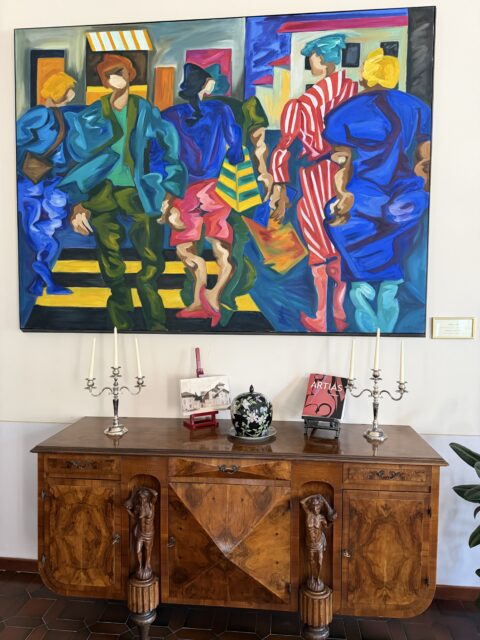
The Villa rewards slow-looking.
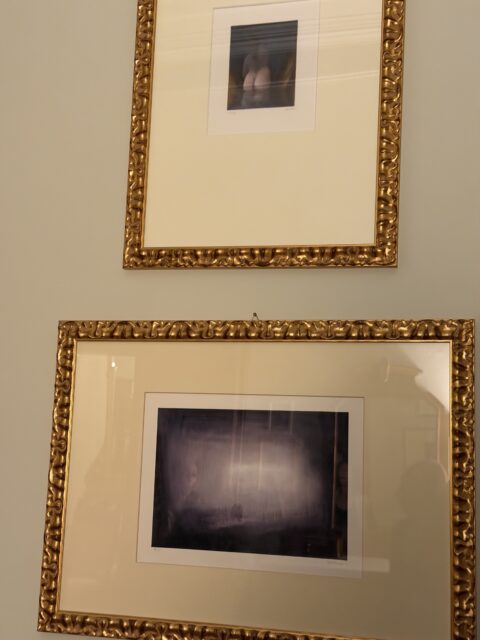
Such as at a mid-19th-century lady in an oval gilt frame who wears black velvet; hair parted severely in the middle. She clutches an ermine stole and gazes out at the modernists across the hall with a look that suggests patient amusement. Limited-edition prints, among them a windblown etching of trees on red earth, numbered 12 of 75. A pair of misty, signed photographs seem to dissolve when we approached.
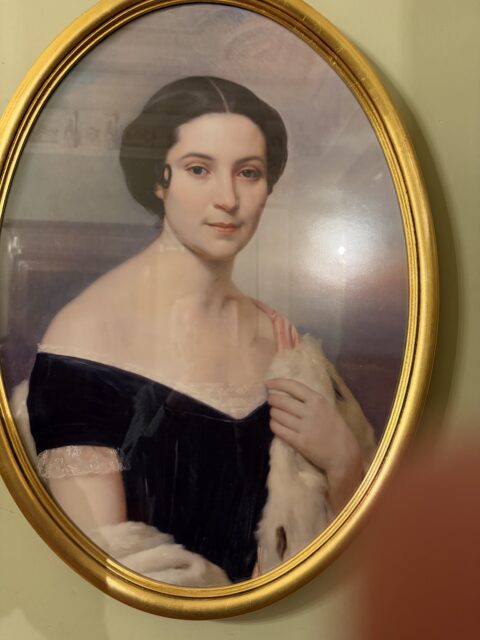
Quiete’s Countess
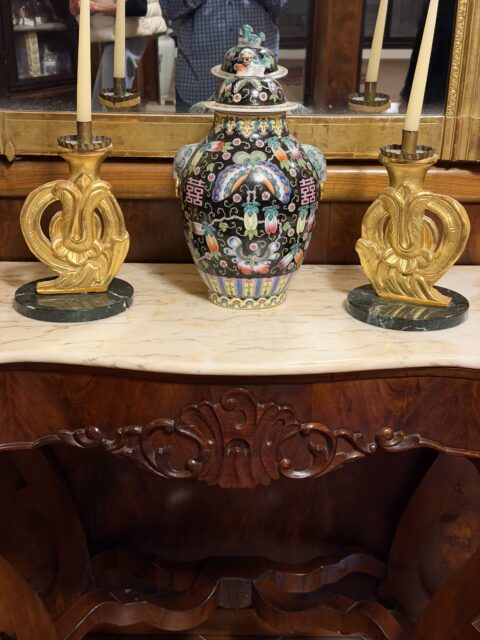
One of our favorite objects at this address was a black-ground Chinese lidded jar on a marble console, crowned with a guardian lion. It is painted with butterflies and pink 囍, the “double happiness” character that traditionally blesses a marriage.
In any other region, the piece would be admired for its beauty and the beauty of its message. In Macerata, however, the hometown of Matteo Ricci, the Jesuit we “met ” en route, the man who carried Western clocks and Euclid to the Ming court, the jar felt like a footnote to the whole visit.
This corner of Italy has been looking East for 400 years.
Two nights there confirmed what we came to the Marche hoping to find: places run by people with a point of view, where the history is not polished into an insistent theme. A hunting lodge became a hotel, then quietly morphed into one of the more surprising small galleries in the region.
Virgilio Guidi is another modern master directly linked to the Villa, whose current owner is a passionate collector with a great eye.
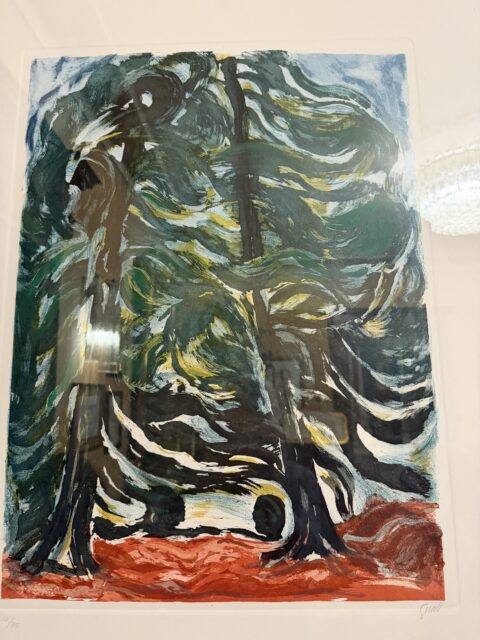
The story goes that while a guest in 1974, the artist was so moved by the estate’s ancient park that he painted his celebrated “Grandi Alberi” (“The Big Trees”) cycle there.
The trees that inspired the work still stand in the park.
Artias’ bright, pulsing are the yang to Guidi’s yin, and great complements to the original Chinese jar in the dining room. We left the Villa thinking of Guidi’s “Grandi Alberi” as bringing the light, and of Artias’s work as Fauve fireworks, redolent of Cubism.
Our guide Alessandro walked us through Macerata, a hilltop town whose university dates back to 1290.
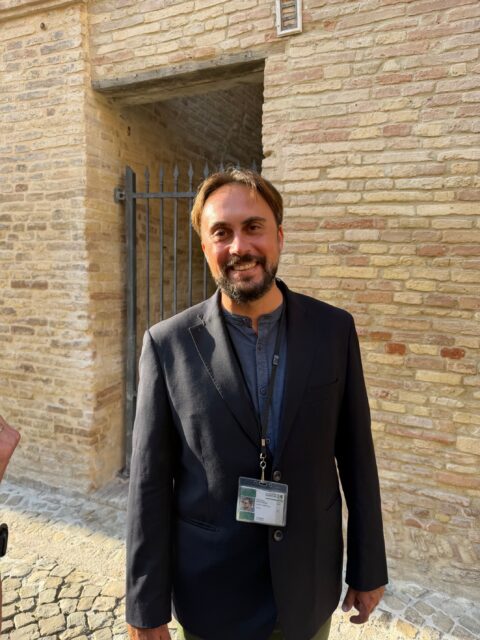
Alessandro, our guide in Macerata. His badge is a Regione Marche tourist-guide license. Italy’s licensed guides pass a regional exam, which is why ours have been top-drawer.
This is a town that keeps surprises up its sleeve.
The first is the Sferisterio, a vast neoclassical arena opened in 1829 for pallone col bracciale, a long-vanished ball game played with a spiked wooden armguard. Since 1921 it has hosted opera instead, and the stars who sang there slept at our Villa, among them Luciano Pavarotti, Plácido Domingo, Rudolf Nureyev and more.
The second is the clock tower on Piazza della Libertà. Its astronomical dial, first built by the Ranieri brothers in 1571, tracks the sun, the moon and the five planets known at the time. At set hours, wooden Magi bow to the Virgin and Child. The clock was dismantled in 1882 and rebuilt from the original plans in 2015. In an apartment building next to the magical clock, owners and guests were out on their balcony at the appointed hour, along with the rest of us gawkers.
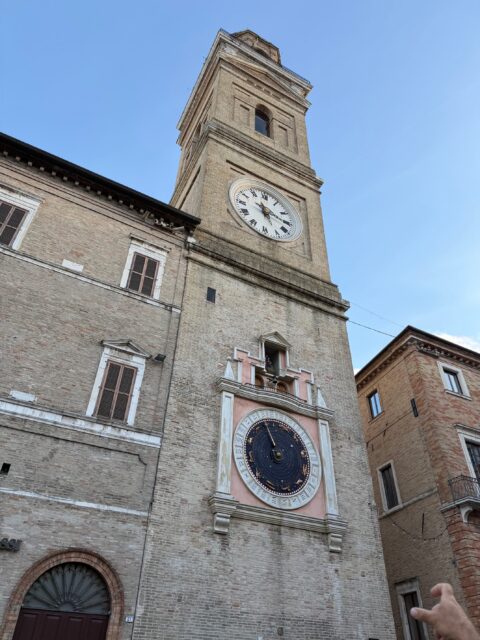
This is the Torre Civica on Piazza della Libertà.
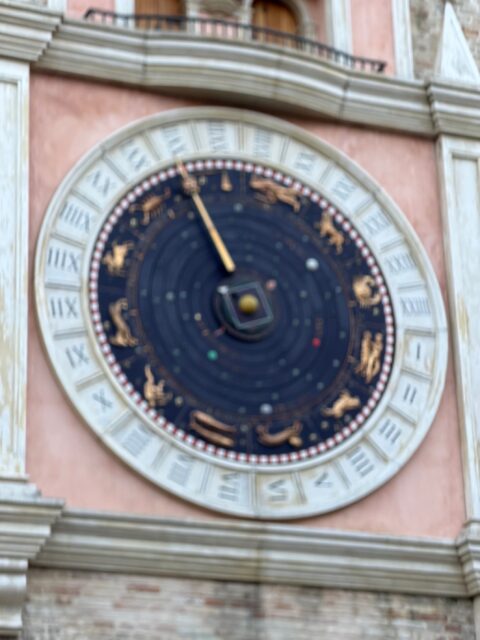
The tower is about 210 feet tall. The original clock, with its automata, was commissioned by the city’s priors and built between 1569 and 1571 by the brothers Giulio, Lorenzo Maria and Ippolito Ranieri, clockmakers from Reggio Emilia. It was removed for good in 1882 after many years of breakdowns. Pictured is a working replica, inaugurated in April 2015.
What makes the lock so special was that it is planetary, as well as astronomical. Besides telling the hours, the dial tracks the apparent motions of the Moon and Sun and the circuit of the five planets known in the Ranieris’ day. The colored dots on the dark disc are those planets. The outer ring runs I–XXIIII because the clock kept the old 24-hour “Italian” time, not a 12-hour day. The little loggia above the dial is for the Magi carousel, which runs twice a day, at noon and at 6 p.m. geocaching.
The master clockmaker behind the replica, Alberto Gorla, also reconstructed the clock with which Father Matteo Ricci astonished the Chinese emperor. That is kept in the Mozzi-Borgetti municipal library. Ricci used Western clocks as his entry into the Ming court, so the tower and the statue below tell the same story.
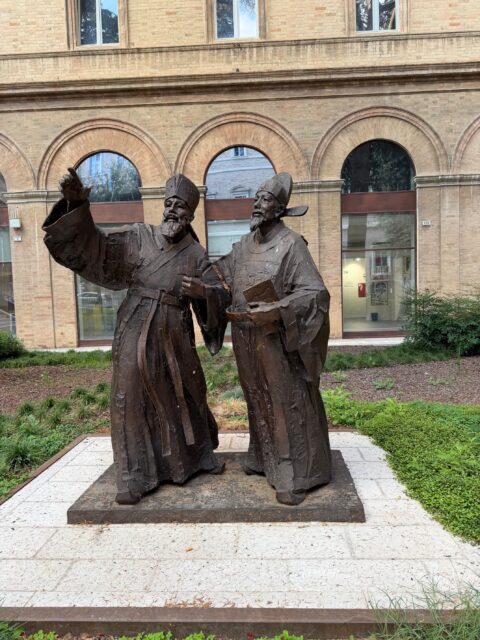
And round the corner stands Macerata’s favorite son, Ricci, cast in bronze in 2024 and is now in an unending conversation with his Chinese friend Xu Guangqi.
Along the way we passed the cathedral with its unfinished facade, the Church of Mercy designed by Luigi Vanvitelli, and the Lauro Rossi Theater.
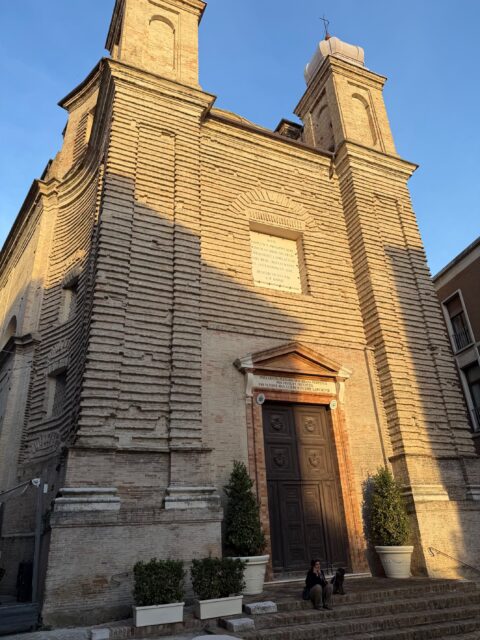
San Filippo Neri. The Latin inscription over the window makes a claim the town is proud of: this is the first church in the world dedicated to this saint. t also records that the church was damaged by an earthquake and restored with public funds by Bishop Claudio Giuliodori in 2012, under Benedict XVI. The words over the door advertise a perpetual daily plenary indulgence for the living and the dead, granted by Pius VI
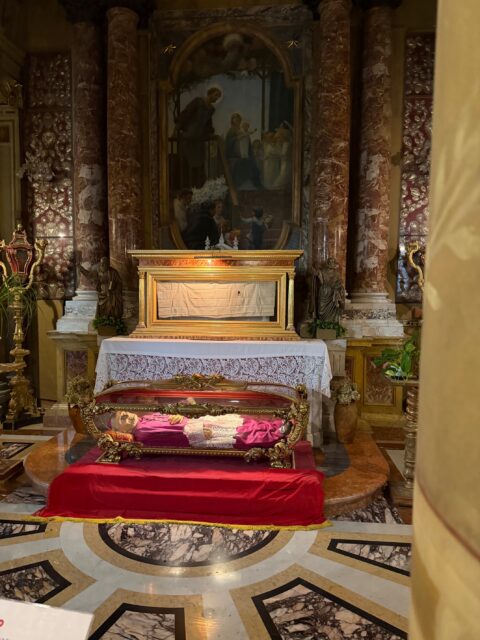
St. Vincenzo Maria Strambi. The cathedral holds his remains; he was bishop of Macerata from 1801 to 1823.
The saint was a Passionist who defied Napoleon. He also links back to San Filippo: after the French expelled the Oratorians, Strambi’s intervention let them return in 1820. Andrea explained that in reliquaries like this one the face and hands are usually fashioned from wax or metal coverings over the remains, so don’t read the figure as an incorrupt body unless otherwise indicated.
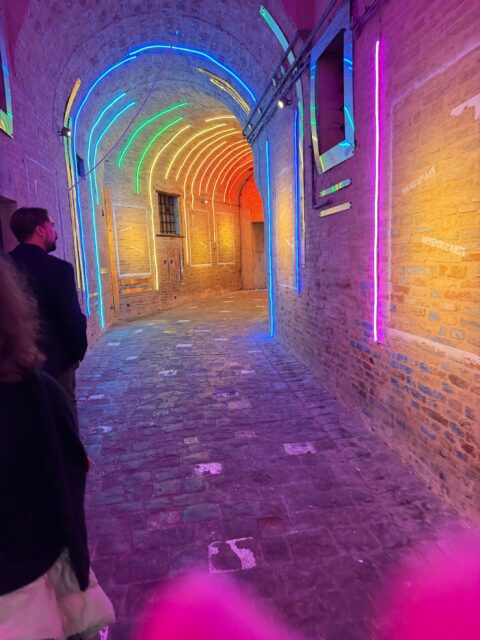
The words projected in this alleyway, “Hang up art” and “Appendi l’arte” (Italian for the same thing) point to a temporary, contemporary installation in a vaulted passage.
Based on the locale, Alessandro thought the alley was tied to Macerata’s Accademia di Belle Arti, which is apparently active in light design. Move over Larry Bell.
Then, at dusk, the alley lit in neon took us from the 16th century back to now.
Loreto: where the Church answered back:
If Urbino is Federico da Montefeltro’s masterpiece, Loreto is the popes’ treasure trove.
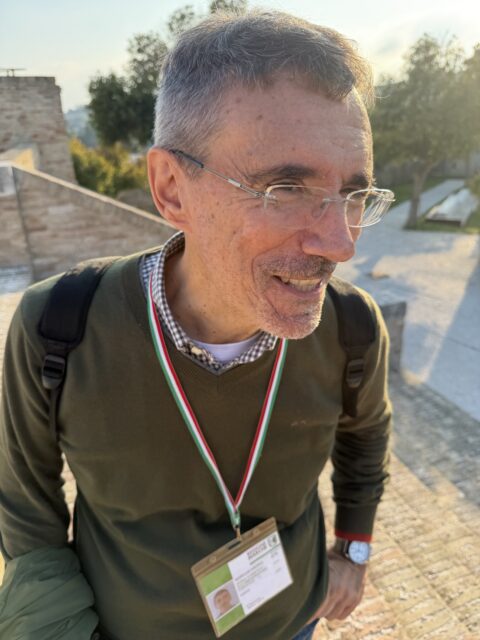
Our guide, Andrea, shared the legend that in the 1290s angels carried the Virgin Mary’s house from Nazareth to this hilltop above the Adriatic. In 1920, the Pope made “Our Lady of Loreto” the patron saint of aviators. Those angels were arguably the first air freight.
The aviation link is no joke. Many of the basilica’s side chapels were donated by different nations and, in the American Chapel, Giuseppe Steffanina’s 1970 murals mix saints and clergy with pilots, aircraft and helmeted figures who look ready for a walk in outer space. (The image was painted the year after Apollo 11.)
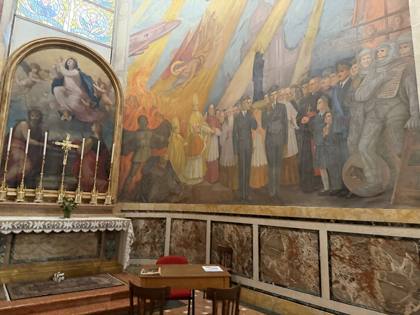
Loreto: modern fresco with aviators (patron saint of pilots).
A church that is also a fortress: the power struggle, set in stone. The gleaming white facade was finished in 1587, under Pope Sixtus V. Inside, the Basilica della Santa Casa, Bramante’s carved marble screen encases the Holy House; Luca Signorelli and Melozzo da Forlì frescoed the sacristies. Look up in Melozzo’s Sacristy of St. Mark, painted around 1477–79: angels carrying the instruments of the Passion float above prophets holding name scrolls, in one of the first domes to combine painted architecture with figures.
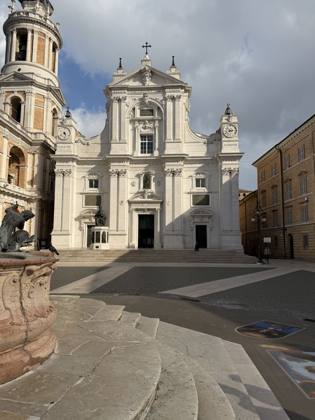
Loreto: Basilica della Santa Casa from the piazza
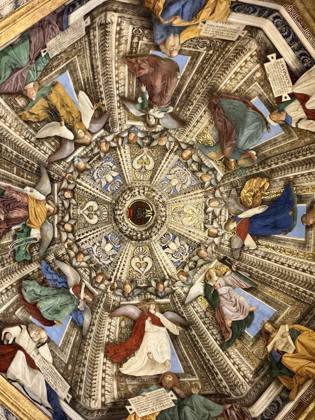
Sacristy dome showcase Melozzo’s angels
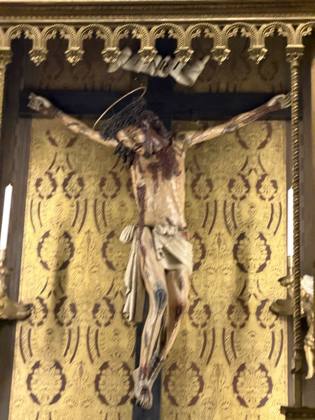
Wooden crucifix inside church. Andrea told us that as you move from left to right the expression on JC’s face is said to change from pain to resignation.
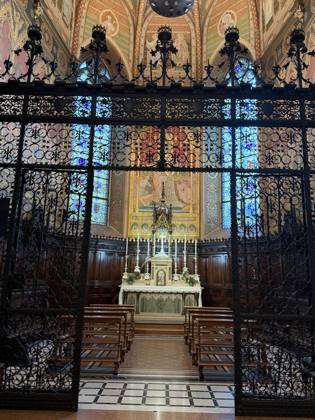
Chapel behind a beautifully crafted iron screen
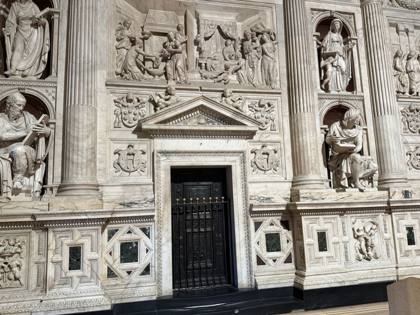
Loreto: Bramante’s marble screen around the Holy House of Mary, or so the legend says. A leap of faith supported by the 100s of believers who surrounded this architectural marvel.
Outside, Andrea pointed out the madonnari, street artists whose sacred images in chalk cover the pavement around the great fountain on Piazza della Madonna. The fountain itself, the Fontana Maggiore, was designed by Carlo Maderno and Giovanni Fontana; its bronzes, cast by the Jacometti brothers in 1622, are a bestiary of winged dragons, eagles and tritons riding dolphins.
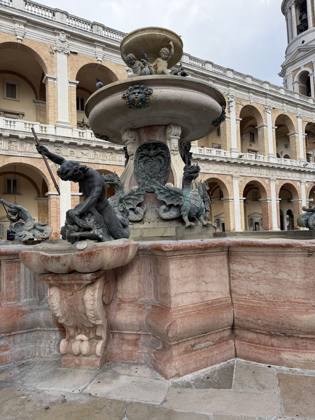
Loreto fountain in piazza, sea-creatures in bronze.
After a week of hill towns, San Benedetto del Tronto was the exhale.: Smeraldo Suites & Spa (1 night):
Front row on the Adriatic, with a private beach, a 450-square-meter spa, and Arca, home to the best dinner of the trip (see above). Our suite was on the top floor and had not one, but two balconies, with views of the Adriatic on one side and mountains on the other.
After a week of hill towns, San Benedetto del Tronto was the exhale.
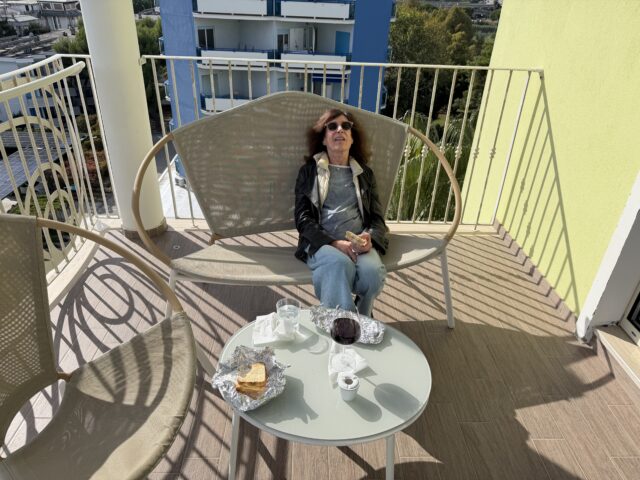
This is the Riviera delle Palme: some 8,000 palm trees line a seafront promenade above a long beach of fine sand and shallow, clear water, which has earned the Blue Flag for clean water every year since 1999.
In the late afternoon we walked along the beach picking up shells and petting local pups.
San Benedetto is a working fishing port, too, with a signature dish, brodetto alla sambenedettese, a fish stew sharpened with vinegar, tomatoes and green peppers. Not on Arca’s menu that night, but the chef had other great ideas.
Out on the south pier, an open-air sculpture museum, the Museo d’Arte sul Mare, has local sculptors carving harbor boulders every summer. Up the hill, the six-sided Torre dei Gualtieri, from the 1300s, marks the old town.
We capped off our late afternoon stroll at the hotel bar where Elia (above) conjured by two perfect vodka martinis. It was Elia who told us not to miss the food at Arca.
The evening ended with a wish upon a star or two from the balcony of our suite.
Sweet, no?
Rome: Hilton Rome Airport (1 night):
A covered walkway to the terminals – exactly what you want – more like what you need – before a morning flight home. For us, the stay was like sipping Listerine after all that wonderful wine.
Along the way: Urbania, Tolentino and San Severino, detours:
Urbania is famous for its handmade maiolica, tin-glazed earthenware the town has produced since the Renaissance, when it was called Casteldurante. Its Palazzo Ducale rises above the river. When the duchy passed to the pope in 1631, much of its treasure, including the duke’s great library, was carted off to Rome, leaving not much behind. Except, of course, the creepy mummies.
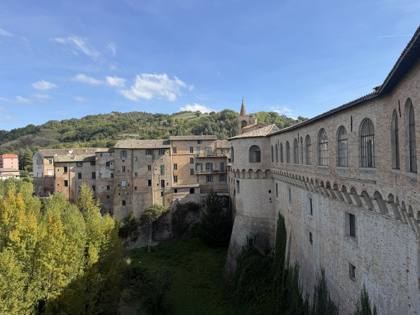
Urbania: Palazzo Ducale above the river. Most of the art was appropriated by the Duke, leaving not much behind.
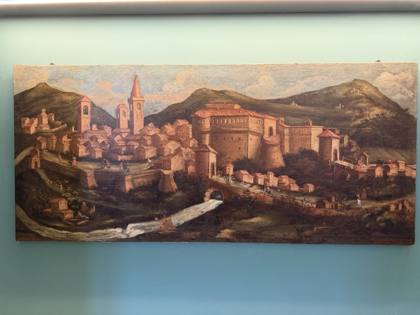
Veduta di Urbania, 18th-century view of the town.
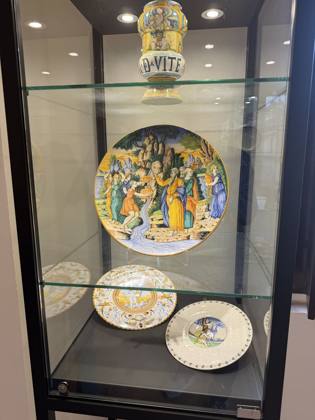
Urbania is famous for its handmade ceramics, particularly maiolica pottery (tin-glazed earthenware), which the town has produced since the Renaissance.
We also stopped in Tolentino en route to Macerata to see the heavily touted Cappellone di San Nicola, a large chapel inside the ornate Basilica di San Nicola, covered floor-to-vault in frescoes that date from the 1320s–40s. They are usually credited to Pietro da Rimini and the Rimini school, painters who learned directly from Giotto, and they show the life of St. Nicholas of Tolentino, plus scenes from the lives of Christ and the Virgin, with people reacting to miracles in a very human way, in keeping with Giotto at the dawn of the Renaissance.
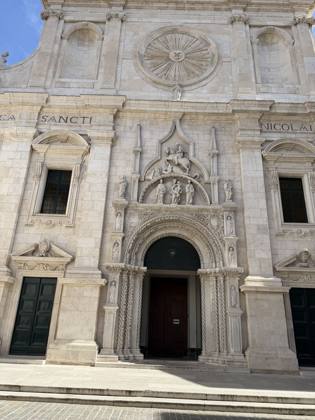
Basilica di San Nicola, Tolentino, facade
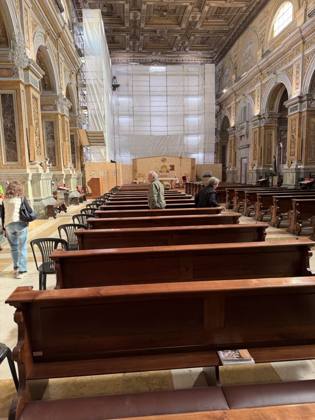
San Nicola nave.
Sounds great, no? Worth the stop. The basilica was open, but inside was under repair. So was much of the town, hit hard by the earthquakes of 2016. But the charming owner of a local pharmacy told us San Severino was worth a stop for the views, so off we went.
The medieval town of San Severino Marche uses its ancient architecture to stage contemporary pop-up installations inside the Castello ruins at the top of the hill. Note: top of the hill.
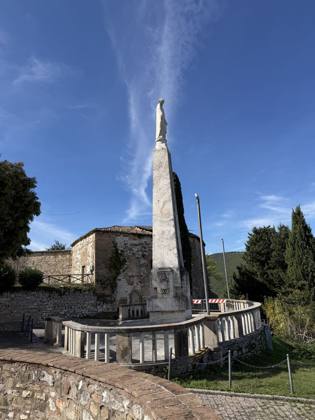
Monument with an obelisk, around midday, San Severino.
If you go:
In Marche/Umbria – really throughout the country – there is one rule of the road: fuggetaboutit. Speed limits are mere suggestions; sidewalks are optional roads. A rented GPS might or might not warn a driver about an upcoming hairpin turn which, when missed, adds serious time to an already long drive.
Should you choose to make it a road trip be sure the GPS in your rental actually speaks English – and gives advance warnings. Know that even with backup from your iPhone, tunnels and valleys can mess with the signal. Also, the narrow streets and walls of these ancient towns argue against anything but feet, a bike, a motorcycle or a very small car. The suggestion is also a rule: these old towns we visited do not allow parking inside their centers. Generally we were directed to dedicated lots just outside the Centro – but finding a spot at popular tourist stops was not easy, even in October.
One thought: Edit. If we were to do it all over again, we would pick no more than two, max three, locations as home base, then take day trips to sites nearby. No one-night stands.
In conclusion:
In Marche and Umbria, time seemed to be moonwalking backwards, and our senses were slapped to wide-awake vitality. In all, the trip was an opulent confection – with a few bumps in the road, (once again literally). But as Sarah of Relais Metelli fame told us over two martinis in the hotel bar: if a couple does not kill each other on a road trip, the marriage is a great success.
Guess that means our relationship is a great success.
As was the trip.
Ci siamo goduti molto il viaggio.
About SmartFlyer:
Based in New York City, SmartFlyer is a full-service, luxury travel agency built for curious travelers. The company crafts exceptional experiences worldwide through vetted recommendations, carefully cultivated relationships and continuous boots-on-the-ground research.
Founded in 1990 by Michael Holtz to offer clients a better, smarter way to book air travel, SmartFlyer today has several hundred advisors based across the U.S., Europe, Asia and Australia.
What’s more, SmartFlyer was recognized as an Inc. Best in Business company in 2020.
To reach our dedicated trip planner, email Kristine.Hilbert@smartflyer.com
No Comments