


25 Nov Poets’ Corner: Rosemerry for Thanksgiving!
Today we sharpen our rhetorical knives and prepare to bury our heads in mashed potatoes in anticipation of that seething cauldron of over-the-top behavior that defines family gatherings over the holiday season 2026.
Thanksgiving usually gets told as a story about the table: the inevitable bird, pies, and crowd, but what about the post script? What about what comes after.
Leave that to favorite Word Woman Rosemerry Trommer. Her poem “After” marinates in the hour when forks are tucked back into a drawer and Big Questions recline on the couch. However, before we go there, a little history and a few fun facts, including several about what Americans have done with, well, what’s left over.
Note: On Monday, December 14, 5:30pm, Rosemerry’s friend and professional colleague Amy Irvine appears at the Telluride Library for a talk and signing for her latest book, “Almost Animal.” Rosemerry joins Amy in support of her latest book of poetry, “The Wonderment.” Between the Covers will be on hand with those books for purchase.

Fun fact: TV dinners were born of leftovers: After a slow Thanksgiving season, C.A. Swanson & Sons in Omaha was stuck with about 260 tons of frozen turkey riding around in refrigerated railroad cars. The fix was a three-compartment aluminum tray of turkey with cornbread dressing and gravy, peas and sweet potatoes, sold for 98 cents. The “TV Dinner” reached stores on September 10, 1953, and sold more than 10 million the next year.
But before the turkey:
The meal Americans call the first Thanksgiving was really simply an English-style harvest celebration. The happening took place at Plymouth sometime between late September and mid-November 1621 and went on for three days. Nearly everything we know about that historic happening comes from two short accounts one by colonist Edward Winslow and another by Governor William Bradford.
According to various sources, Winslow wrote that the Wampanoag leader Massasoit arrived “with some 90 men,” who had killed deer for the feast. So the Wampanoag outnumbered the roughly 50 surviving colonists nearly two to one and venison, not turkey, anchored the menu, along with wild fowl and corn. Bradford, however, did comment on a “great store of wild turkeys” that fall, so a bird may well have made a debut.
But we owe the national holiday to a magazine editor.
Sarah Josepha Hale, who ran Godey’s Lady’s Book (and wrote “Mary Had a Little Lamb”), spent 36 years lobbying presidents for a national day of thanks. Her appeal was ignored by four occupants of the White House until September 28, 1863, when, at 74, Hale wrote to Abraham Lincoln.
On October 3, Lincoln proclaimed the last Thursday of November a national day of Thanksgiving. The words were drafted by Secretary of State William Seward, and came just months after Gettysburg, to a country badly in need of national glue. Hale had already helped put turkey at the center of the table, too, in her 1827 novel “Northwood.” The date held until 1939, when Franklin Roosevelt moved the holiday up a week to stretch the Depression-era shopping season. Critics dubbed the happening “Franksgiving.”
In 1941 Congress settled the matter for good, fixing Thanksgiving on the fourth Thursday of November.
After
by Rosemerry Wahtola Trommer

Rosemerry,. credit Joanne Schwartz.
After the leftovers have been spooned
into storage containers and the
forks
are all snuggled back in their
drawers,
when the few guests who are left
are sprawled on the couch
or curled on the floor,
and we’re sleepy-eyed and sated
and telling stories and laughing
at ourselves, this is my favorite
part
of the day, when all of the fixing is
done
and we settle in with questions we know
we will never answer, and instead
of solutions we are left holding
nothing but ache and love for the
world
and for each other, and somehow
instead of despair, this utter lack
of resolution serves up such
gladness—we’re here to meet
what is hard together.
Postscript:

Four centuries of proclamations, parades and tray dinners, and the best part may still be the one with no set agenda: the couch, the stories, the questions nobody will answer. As Rosemerry put it: “…we’re here to meet what is hard together.”
Happy Thanksgiving from all of us at Telluride Inside…and Out.
Rosemerry more:
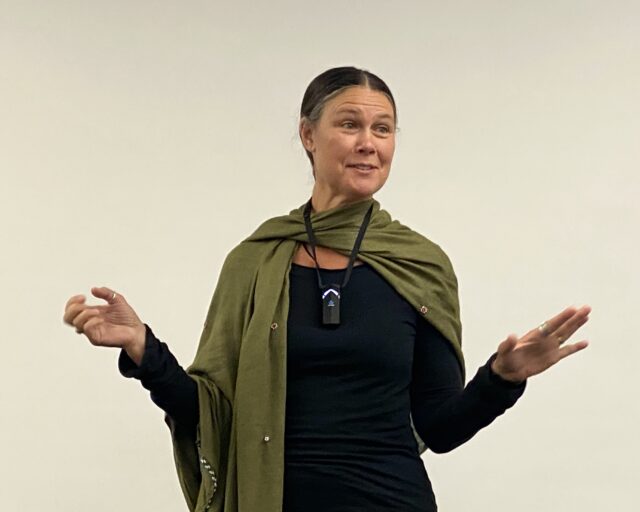
Rosemerry, credit Sister Nancy Bauer, OSB.
Rosemerry Trommer moved to Telluride in 1994, where she worked her as a journalist, substitute teacher, parent educator for Bright Futures, and editor of Telluride Magazine.
Rosemerry and husband Eric owned and operated an organic orchard north of Delta for seven years. For 10 years, she led the Telluride Writers Guild, hosting workshops, literary festivals, a national contest and monthly gatherings.
Rosemerry now travels the world (and the internet), teaching poetry for spiritual organizations, literary organizations, grief organizations, and mindfulness centers.
Website: wordwoman.com <https://www.wordwoman.com/>
Daily poetry blog: A Hundred Falling Veils <https://ahundredfallingveils.com/>
Daily poetry app for your phone: The Poetic Path <https://app.ritual.io/rosemerry>
Podcast on creative process: Emerging Form <https://emergingform.substack.com/>
Newest Books: “The Unfolding” <https://bookshop.org/p/books/the-unfolding-rosemerry-wahtola-trommer/21735297?ean=9781961741164>, “All the Honey” <https://bookshop.org/p/books/all-the-honey-rosemerry-wahtola-trommer/18666020>
TEDx: The Art of Changing Metaphors <https://www.youtube.com/watch?v=eXC3-ZFkhDo>
Poetry album Risking Love<https://rosemerrywahtolatrommer.bandcamp.com/album/risking-love>