

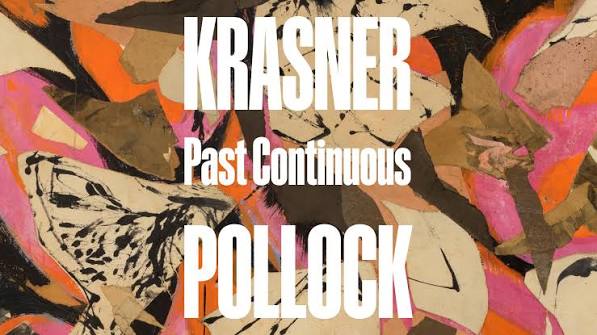
04 Oct TIO NYC: “Krasner and Pollack – Past Continuous,” A Revelation!
This is the first major New York dual survey looking at the full career arcs of Abstract Expressionist peers/spouses Krasner and Pollock side-by-side. The happening brings together over 120 landmark paintings, works on paper, and rare artifacts. Seeing it proved to be a course correction order of magnitude ginormous. In The Met’s “Krasner and Pollack: Past Continuous,” Lee Krasner eschews the role of “Mrs. Pollack,” the shadow to Jackson Pollack’s lost (and briefly found) boy, Peter Pan 2.0. Their breathtaking show is a feast of pure painting at its most physical. Open through January 31, 2027. Don’t miss it.
Both Lee Krasner and Jackson Pollack were part of the rupture that came to be known as Abstract Expressionism. However, this post-WWII movement, one that marked the shift of the center of the art world from Paris to New York, is usually told as an heroic, fraternity story that ended around 1956 with Pollack’s death. (Also the year Warhol and Pop were beginning to flex.) However, with this blockbuster, Krasner clearly changes the conversation, breaks the so-called ending. Her Umber paintings, the late color work, and the stunning collages carry Ab Ex concerns into the 1980s and beyond.
We all know why Pollack matters in the history of art. The man who came to be known as “Jack the Dripper ” actually changed what a painting could be. Roughly between 1947 and 1950 Pollack laid the canvas on the floor where he poured, flung, and dripped paint onto it from all sides.
Why did that matter?
For the aforementioned geography shift of the center of the art world across The Atlantic to New York.
For another, Pollack’s canvases have no focal point, no figure against a ground, and no top or bottom in the traditional sense. That wee fact broke with five centuries of European composition, including Cubism.
And “action painting,” the term critic Harold Rosenberg used to describe Pollack’s work, became a thing.
Krasner matters first for her historical role. She was the better-trained artist when the two met in 1942, having studied with Hans Hofmann and metabolized Matisse, Picasso, and Mondrian far more rigorously than Pollack had. She brought him into the circle that made his career. And, a fter his death, Krasner managed his estate and largely shaped how history represented him.
More importantly “Past Continuous” declares in no uncertain terms that the longer we are privileged to look at Krasner’s body of work the stronger it all looks and feels: dense, glyph-like all-over grids; studios colleges of the 1950s, built from her own torn-up drawings and his discarded canvases; Umber and Night Journeys paintings (1959–62), huge, violent, gestural canvases in umber and cream, made at night in Pollack’s old studio when the artist was grieving so hard she could not sleep; and her return to color led into the hard-edged late collages of the ’70s.
In fact, so impressive is Krasner’s art it could be argued that Pollock had one radical breakthrough – but on his short and troubled journey, Krasner’s achievement was four decades of deliberate reinvention. She repeatedly destroyed her own style to create another Phoenix. Seeing their work together undoes the myth of the solitary, sulking genius who wanted nothing more than to out-Picasso Picasso. Breakthroughs came out of a two-person, on-going studio conversation. But only one partner kept the story going for 30 more years.
Did Pollack succeed in his lofty goal? Yes and no. He did become what Picasso had been for the previous generation, the figure every serious painter had to reckon with. Krasner is said to have recalled her husband throwing an art book across a room and complaining that Picasso had already done everything. The answer to Pollack’s frustration? Stop trying to beat Picasso at his own game. And just like that Pollack’s drip paintings got rid of Cubist space altogether.
Pollack also took over Picasso’s role of artist as myth. Hans Namuth’s 1950 photographs and film of Pollock pouring paint created the American celebrity-artist, a line that runs straight to Warhol and everyone’s else who went on to experience their 15 minutes of fame.
Where he failed in the dethroning was being Picasso meant reinventing yourself for 70 years. Pollock had about four peak years, 1947 to 1950, then burned out like the fast-moving meteor he was.
Truth be told if anyone in that marriage worked the way Picasso did, i.e. restlessly tearing down their own style and rebuilding it decade after decade, it was Krasner. So yes, Pollack made the single move that displaced Picasso. But Krasner had the career that most resembled his.
For a much fuller story (and great images), read this article by Amei Wallach, an art historian and long time friend of Krasner.
No Comments