


28 Sep TIO NYC: “Maybe Happy Ending + Museum Shows!
Unmissable: a painting by a Wiener Werkstätte artist Wilhelm List at The Jewish Museum. (Whole show is great.) Also “Musical Bodies” at The Met and “Maybe Happy Ending” – if you can maybe still get tickets. Taryn Simon installation at The Guggenheim, well, up for debate.
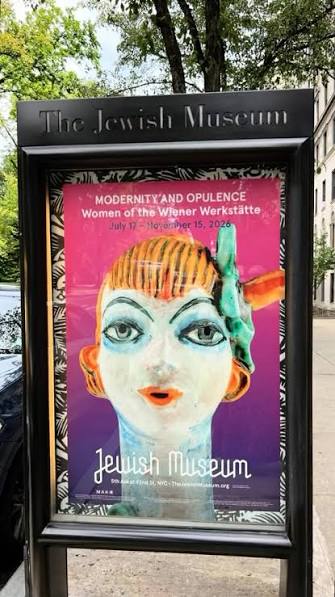
The “Secession” was a breakaway movement. In Vienna in 1897 a group of younger artists quit the Künstlerhaus, the official artists’ association that controlled exhibitions in the city. The renegades found the institution too conservative, commercial and closed to what was happening everywhere in Europe.
The group’s motto: “To every age its art, to art its freedom.”
Wilhelm List co-founded “Secession” with Gustav Klimt (“Woman in Gold’).
And it is his oil, titled “Young Woman in Undergarments,” we described as “unmissable.” The oil is featured at Jewish Museum’ in “Modernity and Opulence: Women of the Wiener Werkstätte,” on view through November 15, 2026.
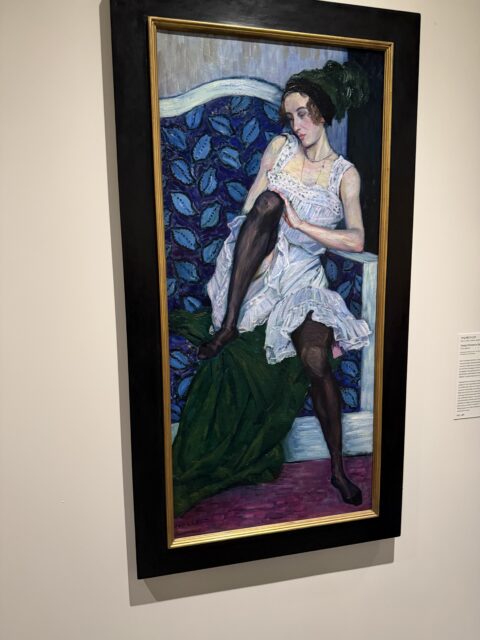
“Young Woman in Undergarments,”courtesy John Fitzpatrick.
The image, a young model, dressed only in undergarments and black stockings, rests on a settee. (Story is the woman is likely List’s lover and favorite model Wally Neuzil.) Her loose chemise and umbrella drawers are associated with dress reform and a movement away from the constraints of the corset. So the painting reads as a portrait of a “new woman,” not just boudoir peek-a-boo.
“Young Woman in Undergarments,” is more than twice as tall as it is wide, the vertical scroll-like format common in Secession work, very much influenced by Japanese art. The sensuous body and the patterned settee compete for our attention, a dynamic that helps explain why the composition is as alluring as it is modern.
The List work is a snapshot of Secession values: fine-art painting (portrait of lady) that doubles as a showcase for applied design (the settee).
“Opulence” is important because Secession is mostly remembered as the vision of a few good men – but in actual fact the movement was largely made, worn and paid for by women, many of whom history (namely the Nazis) then tried to make disappear.
At The Met:
• Ancient Egyptian clappers carved as human hands.
• Italian and German violins with a carved human head where the scroll should be.
• Figural drums from Africa.
And have you noticed we have stopped noticing that a violin, for instance, features a neck, belly, back, shoulders and ribs?
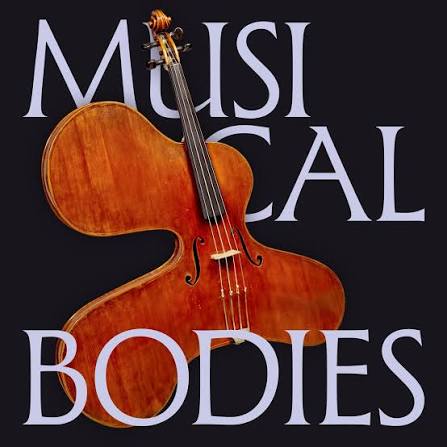
A wise, whimsical show at The Met titled “Musical Bodies” runs alongside the museum’s Costume Art, the Costume Institute’s show about the dressed body. The pairing is intentional, meant to read as a leitmotif of the museum’s fall/winter season which is about the body as the base unit of art. Man as the center of the universe. Didn’t the Renaissance have something to say about that?
The exhibit also rhymes with the aforementioned Jewish Museum show, both arguing that “decoration” and “craft” objects can and do carry personal identity, sexuality and politics as seriously and effectively as any painting.
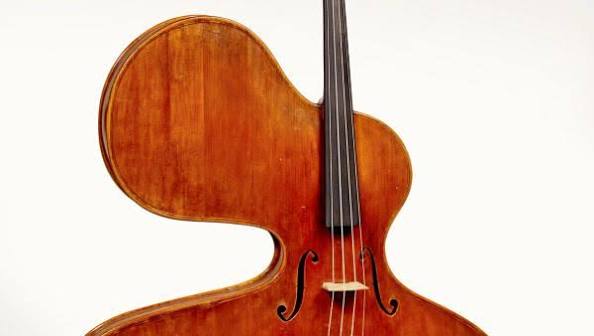
Image courtesy The Met.
According to Met lore, the show started from a single question the curator of the Met’s Department of Musical Instruments kept asking herself: Why are so many instruments shaped and decorated like the human body?
Seven years later the answer Strauchen-Scherer arrived at is this: for most of history music has been central to who we are, so we effectively build ourselves into the tools that make the sounds. The curator’s two-way logic is implicit: our body was the first instrument(clapping, whistling, beatboxing); in turn we fashioned instruments to exploit our familiar shape.
“Musical Bodies” is an equal opportunity employer. For example, one room highlights Titian and Degas; Nam June Paik’s TV Cello; one of Prince’s key guitars; the circular PianoArc built with Lady Gaga’s keyboardist, Brockett Parsons; and ancient rattles.
That covers 4,000 years, with no condescension toward pop.
Nice work if you can get it.
At the Guggenheim
Taryn Simon’s “Father Country I Do Love You” at the Guggenheim is the rare America 250 show with real hutzpah. On the surface the sprawling photography tells the life of one unnamed FBI agent in 42 “chapters. The deeper message is about how knowledge fails. Does it land?

Image courtesy The Guggenheim.
The show’s curator filled the Guggenheim rotunda with surveillance, foreign intervention – and the ripple effects of one retired FBI agent’s career from the TWA Flight 800 wreckage to the rubble of the Pentagon in 9/11. This is the very first rotunda show by a photography-based artist, nearly a decade in the making, and it extends Taryn Simon’s long inquiry into who gathers evidence and who gets to make it mean something.
For us, though, the ambition winds up feeling like overload, too much of what might have been a good thing. More than 1,000 photographs and thousands of words of wall text turn the museum’s spiral into what felt like an uphill reading assignment.
Simon’s show is about unaccountable power and its impacts but, at its heart, the happening sits on a problem the show never wholly resolves: the artist’s critique of unaccountable power is built on an anonymous source that no one can check, framed by her father’s stories that even the artist admits she never fully got to the bottom of.
“Maybe Happy Ending”:
Skeptical about a love story starring two robots? In our view, “Maybe Happy Ending” earned what Taryn’s Simon’s show does not: big feeling and not a wasted gesture – or firefly.
The story: In near-future Seoul, two outdated helper robots live alone in an apartment building for “retired” models, a surrogate for retirement homes where blue hairs often get warehoused.
Oliver is cheerful, rule-bound, uptight– and still waiting for the owner he is sure will return for him. Claire is newer, a Model 5, sharper and more cynical. But her charger, her life’s blood, is failing slowly but surely.
A borrowed battery charger into a road trip to Jeju Island to see the last fireflies and find Oliver’s owner. Along the way the pair fall in love, a feeling neither was programmed for. Then the “couple” are forced to face what is inherent in their design; they are wearing out. Doomed.
Oliver and Claire consider erasing their memories of each other to spare themselves the pain. Because they are machines, the show can talk about decline and death, love and. loss, with a clarity that would feel soap operatic or overly maudlin with humans playing the characters in an existential pickle.
The objective observer position of the audience is what lets joy and grief land so hard.
The play’s central question: Would we choose love if we knew exactly how much losing it will hurt? The musical drama’s title’s “Maybe” is the whole answer.
“Maybe Happy Ending” is at the Belasco Theatre, 111 West 44th Street.It runs 1 hour 40 minutes with no intermission. Tickets are on sale so far through February 28, 2027.
No Comments