24 Aug Telluride Science Town Talks: “Earth’s Most Resilient Life, Our Greatest Hope,” (or Microbes), 8/25!
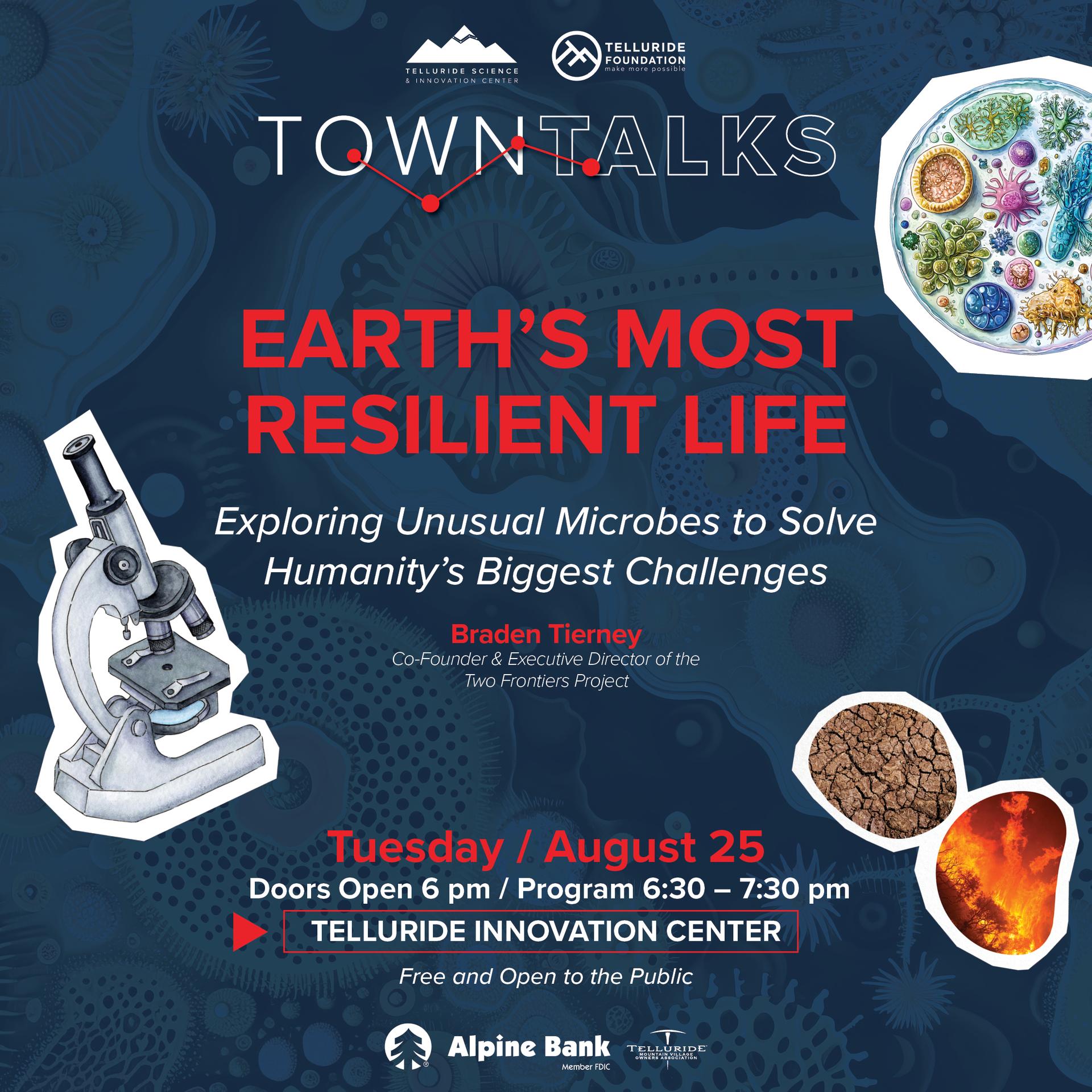
This coming week the 2026 Telluride Science Town Talks series continues with “Earth’s Most Resilient Life, Our Greatest Hope: Exploring Unusual Microbes to Solve Humanity’s Biggest Challenges.” The talk features Dr. Braden Tierney.
Event takes place Tuesday, August 25. Doors 6 p.m.; talk, 6:30- 7:30 p.m. in town at the Telluride Science Innovation Center.
Town Talks are FREE and open to the public.
Visit telluridescience.org to learn more about Telluride Science and the historic Telluride Depot, now the Telluride Science & Innovation Center. The venue is the permanent home for Telluride Science and a global hub of inspired knowledge exchange and development where great minds get to solve great challenges.
The 2026 Telluride Science Town Talks series is presented by Alpine Bank with additional support from the Telluride Mountain Village Owner’s Association.
Go here for more about Telluride Science.
Go here for more on Town Talks.
“Microbes are humanity’s greatest natural resource,” Dr. Braden Tierney.
So it’s not oil. Not gold. It is the invisible stuff: the bacteria in your gut; the fungus in your soy sauce; the organisms that gave us antibiotics and COVID tests and the ability to engineer a genome.
And that’s barely scratching the surface.
Microbes those tiny living machines have had billions of years to evolve; Tierney believes that if harnessed correctly, they could quite literally solve a laundry list of persistent problems.
On August 25, Tierney comes to the Telluride Innovation Center to talk about his microbial work.
Tierney is cofounder and executive director of the Two Frontiers Project, an independent research nonprofit that goes to Earth’s most extreme places – volcanic seeps, methane-belching mud volcanoes, alpine mine drainage – hunting for microbes with superpowers.
Tierney got hooked as a teenager, when a mentor described microbes as “self-assembling machines,” tiny living things, out in nature, capable of solving almost any problem if we can only learn to work with them.
For example: Tierney found a microbe named Chonkus.
Chonkus was discovered in the volcanic shallows off an Italian island. This cyanobacterium grows fast, eats CO2, runs on sunlight, and (unlike most microbes) sinks.
That last trick is a big deal. When scientists use microbes to manufacture a new thing – a bioplastic, a drug, captured carbon – they grow huge tanks of the organism, but the microbes are tiny cells floating diffusely in a lot of water. Before you can extract the useful product, you have to gather all those scattered cells together into a concentrated mass. That gathering step is expensive: Tierney says it’s roughly 30% of the total cost of making anything from microbes. But Chonkus is pretty heavy and does that part for free by simply sinking to the bottom.
Now scale up that thinking. Tierney imagines a world where the oil companies of the future are biodiesel companies. He says the moment someone figures out how to grow microbial oil cheaper than a barrel of crude, the whole game shifts, and it’s only a matter of time… A world where you can make almost anything you want from a consortium of microbes: plastics, medicine, fertilizer, food, oil….
The catch? Getting from the micro to the macro.
Coaxing something that thrives at the scale of a single invisible cell to deliver at the scale of a planet is the hard part. But we can all be thankful brilliant people like Tierney are working on the challenge.
Tierney’s talk will cover interesting finds from Colorado hot springs and Telluride’s own mine drainage gathered just days before his talk. His hope? We will walk out seeing the landscape differently: beautiful, complex, and full of potential solutions to the problems we face: “Another dimension of life and biology that’s around them.”
Dr Braden Tierney more:
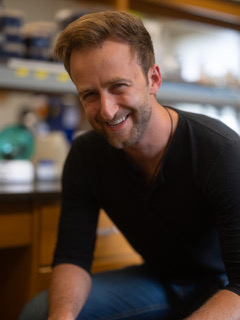
Braden Tierney, courtesy Telluride Science.
Braden Tierney co-founded the Two Frontiers Project and serves as its Executive Director, leading a nonprofit biotech lab that looks to organisms thriving in Earth’s harshest environments for solutions to problems like forever-chemical pollution, agriculture, and ecosystem collapse.
Trained as both a microbiologist and a data scientist, Tierney has traced the hidden work of microbes across wildly different worlds, from the human gut to low-Earth orbit. His Harvard Medical School PhD produced machine-learning tools that flag disease-linked microbes across records from hundreds of thousands of patients, and he went on to run clinical trials for microbiome-based therapies.
In the years since launching Two Frontiers in 2022, Tierney has mounted expeditions on five continents, helped identify one of the most efficient carbon-capturing organisms on record, and launched a sustainable aquaculture startup.
He also directs Exposomics & Microbial Data Science at Harvard Medical School.
Lucja Barker, more
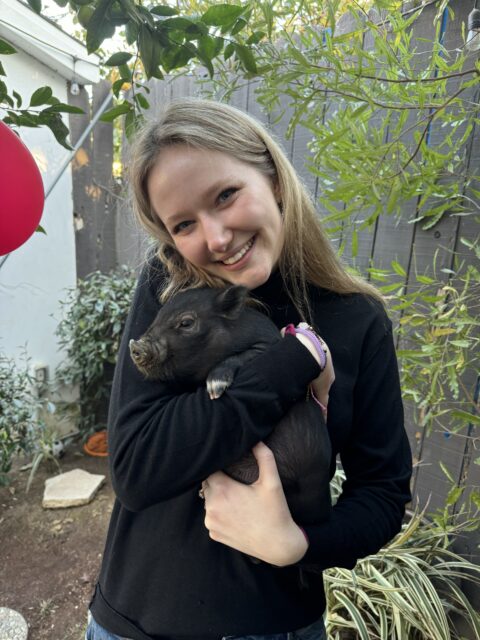
Lucja Barker grew up in Telluride and Los Angeles. She studies environmental science and political journalism at NYU. And was delighted and honored to have been working as an intern at the Telluride Science Center this summer.
Sorry, the comment form is closed at this time.