

29 Aug Telluride Museum: “Evening with Ken Burns,” Encore, 8/30!
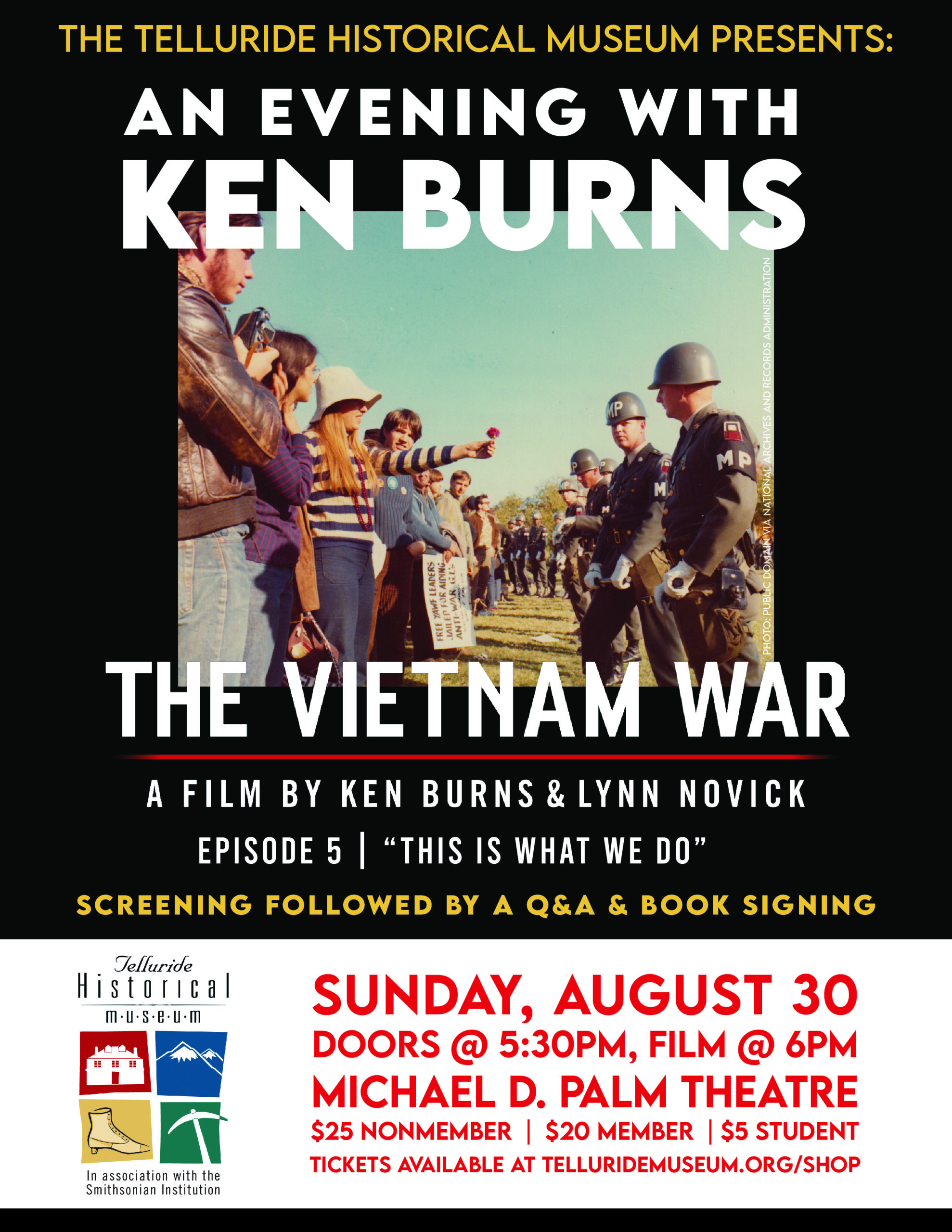
The Telluride Historical Museum once again presents “An Evening with Ken Burns.” This year’s program features Episode 5 from the documentary series “The Vietnam War.”
Event takes place Sunday, August 30. Doors: 5:30 pm; screening, 6:00 pm, Michael D. Palm Theatre. The evening includes the screening, post-film Q&A, and book/DVD signing.
Find out why historians say more Americans get their history lessons from Ken’s films than from any other source.
Tickets $20 for museum members; $25 for non-members; $5 for students. Tickets here.
Please scroll down to listen to Telluride Inside…and Out’s (TIO) most recent podcast with Ken Burns.
And go here for more on Ken Burns in Telluride.
Ken Burns has been making films for about 50 years. It is a well known fact his documentaries have been honored with hosannas. Among his major awards: 17 Emmys, two Grammys, and two Oscar nominations.
Over the years, Burns has earned a reputation for an infectious gravitas – for delivering steak, rather than just the sizzle – through his work and at his rare public appearances such as the upcoming program in support of the Telluride Historical Museum. This year’s screening features Episode Five, “This Is What We Do,” from Burns’ celebrated, 18-hour Vietnam War series and a Q & A.
For Burns, who comes to town annually for the Telluride Film Festival, the summer evening at The Palm is a chance to share some of his favorite themes in depth: American identity and individuality, race, and democracy writ large. Over the years, he has filtered those notions through the lens of baseball, National Parks, The Civil War, WWII, the uniquely American phenomena known as jazz and country music to name a few of the subjects of his eye-opening, mind-blowing documentaries.
Last year the Pew Research Center polled people around the world about whether they thought life had been better or worse in their countries about 50 years ago. Some Americans actually answered it was better, though protest marches were taking place around America, crime was surging, and race riots broke out in Detroit, Newark, Milwaukee and other cities. We lived in smaller houses, consumed much worse food in large quantities, worked longer hours and died, on average, according to one online source, seven years earlier.
And we were embroiled in the Vietnam War.
Ken Burns’s “The Vietnam War,” was 10 years in the making. The series brings the national crisis and the chaotic epoch it all defined viscerally to life. The doc was also arguably one of Burn’s most challenging projects.
Burns & Co. at Florentine Films chose Episode 5 of the series, “This Is What We Do,” for the 2026 happening at The Palm.
Over the six months this episode takes place, the war has exploded in scale. By the end of 1967 the number of U.S. troops had risen from about 11,000 in 1965 to more than 500,000; the Army estimated it had killed roughly 200,000 North Vietnamese; and more than 20,000 Americans have died.
We witness the brutal fighting near the DMZ — Con Thien — and the central highlands, culminating in the Battle of Dak To, one of the bloodiest of the war.
Episode 5 also surfaces the scandal of the M16 malfunctioning in the field costing many lives.
While it covers a period of only six months, “This Is What We Do” highlights the giant maw between official optimism and real world.
These images from Florentine Films speak volumes:
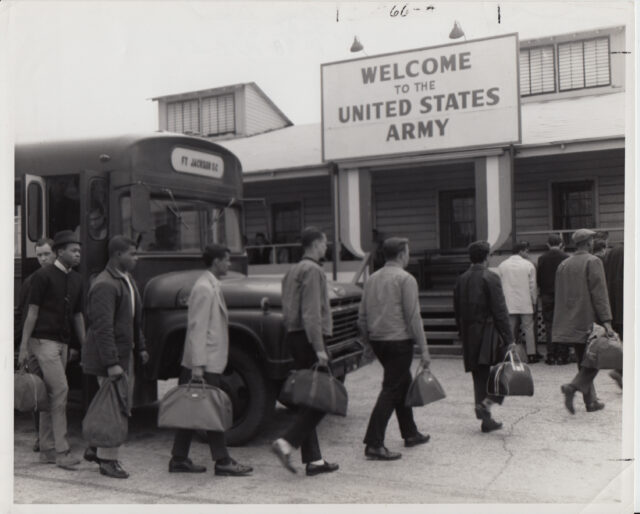
Credit: Natl. Archives and Records.
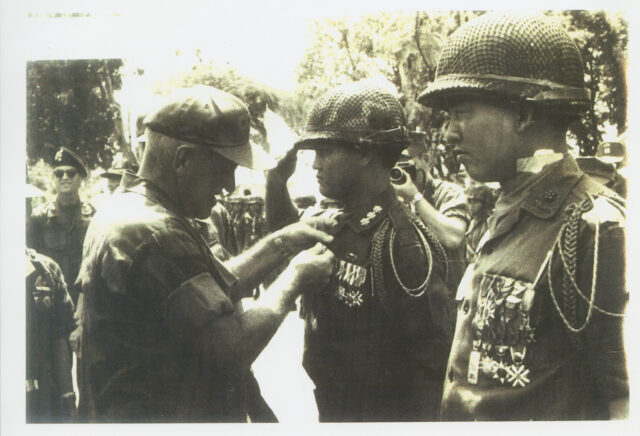
Captain Harry Tran Ngoc Hue received the Silver Star Gallantry Cross from General Creighton Abrams – Commander in Chief – US Forces, Vietnam in 1968 after the Tet Offensive.
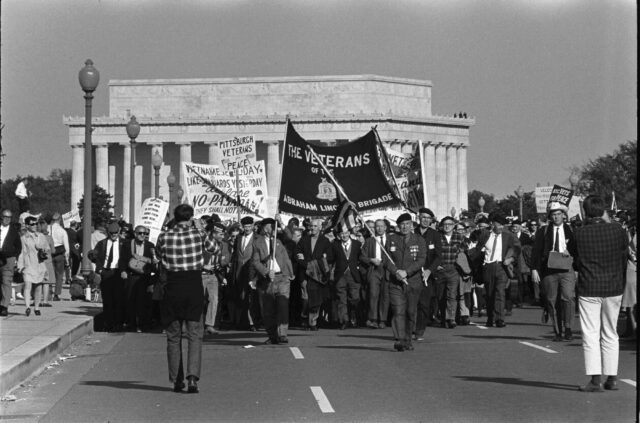
Vietnam War protestors Pittsburgh Veterans for Peace at the March on the Pentagon. October 21, 1967.
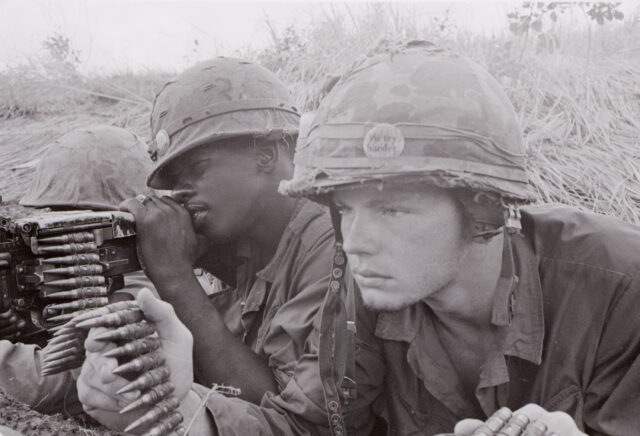
November 20, 1967: OPERATION ESSEX – A Marine machine gun crew from “G” Company, 2nd Battalion, 5th Marines, on Hill 170. Left to right: Private 1st class J.L. Duckworth, Corporal H.T. Hudson, and Private 1st class D.O. McPherson. Photo by: Cpl Aker
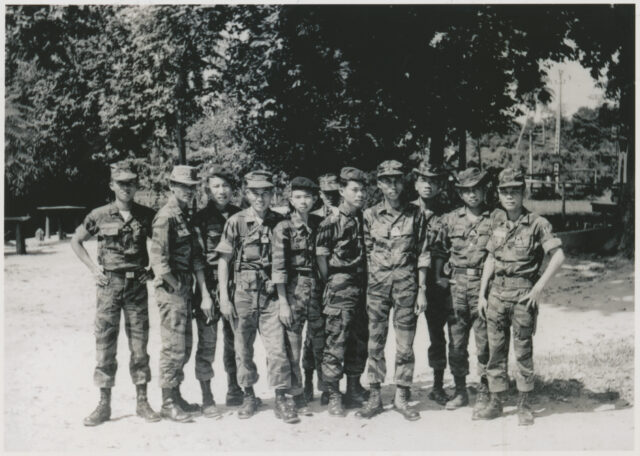
Staff and Company Commanders, 4th Battalion Vietnamese Marine Corps (VNMC). Tran Ngoc Toan – second from left. 1964
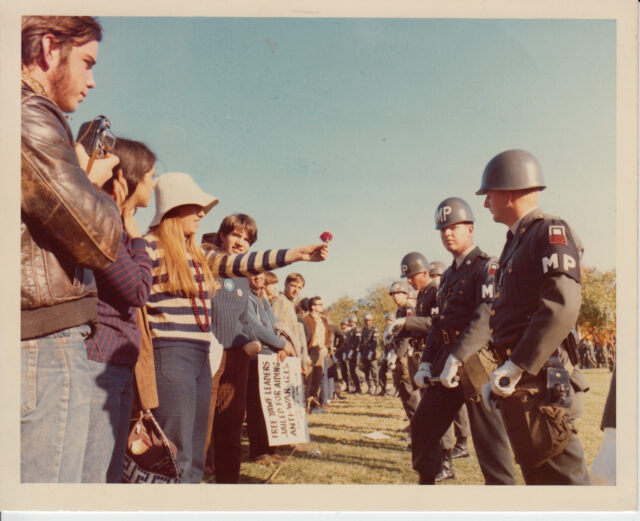
A female demonstrator offers a flower to military police on guard at the Pentagon. October 21, 1967. Credit Natl Archives & Record Admin.
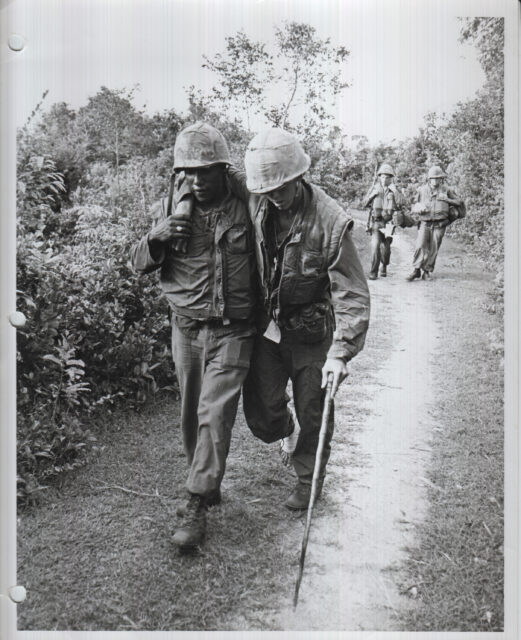
December 10, 1965: OPERATION ACTION – United States Marines participate in Operation HARVEST MOON. Credit, Natl Archives & Records.
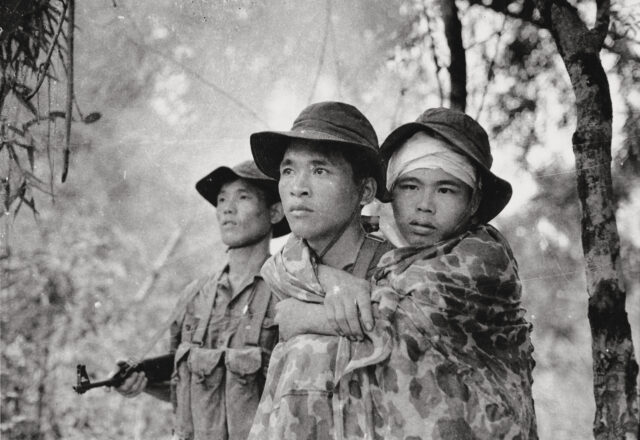
Location and dated unknown Viet Cong guerilla Bui an Quang carries a wounded friend during action along the trail on the Cambodian border. Bui bore his comrade for two hours while under attack. Although the Viet Cong led the resistance early in the war, after 1968’s Tet offensive, North Vietnamese troops did most of the fighting in the South. Credit Unknown/Doug Niven.
Back then, Hanoi is secretly laying plans for a massive surprise offensive — the Tet Offensive that detonates in Episode 6 — even as the Johnson administration reassures the American public that victory is in sight. Defense Secretary Robert McNamara, who had escalated the war, is by now consumed with private doubt and gets pushed out.
“This Is What We Do,” ends with the turbulence of late 1967: the antiwar march on the Pentagon; the crackdown on protesters; the burning of draft card. And it sits inside the racial unrest of what became known as the “long, hot summer of 1967.”
Hard not to draw parallels between 1967 and the present — but back in 2017, Burns and Novick deliberately declined to draw those parallels, trusting viewers to sort out all the tantalizing details for ourselves.
Of note: This screening marks an encore for “The Vietnam War.” In 2018 — the fifth “Evening with Ken Burns” — the Telluride Museum showed Episode 6, “Things Fall Apart.” So 2026 marks a return to Vietnam, and to the chapter that comes just before the one the Museum screened eight years ago.
Why return to this series? Why the earlier chapter now?
To find out more, check out TIO’s conversation with Ken Burns.
Ken Burns, more:
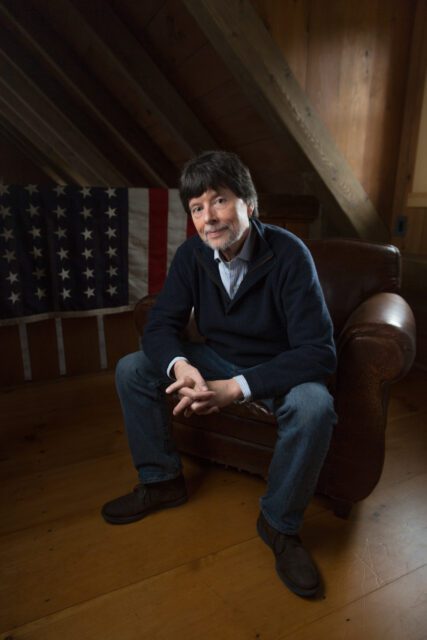
Ken Burns, Credit, Evan Barlow (2018)
Ken Burns claim to fame can be summed up in a nutshell: his ability to craft compelling narratives that draw viewers in and make history accessible and relatable.
The award-winning documentary filmmaker known for his work on periods in American history and American culture. Often produced with WETA-TV and the National Endowment for the Humanities for broadcast on public television by PBS (Public Broadcasting Service), his films and television miniseries celebrate and examine the American experience with an unflinching eye.
In Telluride, Burns is an honorary homie. The iconic filmmaker has about a four-decades relationship with our town, which he is known to describe shamelessly as “my lover.”
Since the Academy Award-nominated “Brooklyn Bridge,” Burns went on to direct and produce some of the most acclaimed historical documentaries ever made, recounting the histories of jazz, the Civil War, baseball, Prohibition, the decade-long calamity known as The Dust Bowl, the Roosevelts, the Vietnam War and the history of country music.
Burns has a well-deserved global reputation for in-depth meditations on Americana, projects on which he often wears many hats: writer, cinematographer, editor, and music director – in addition to producing and directing.
Many of his celebrated documentaries premiered at the Telluride Film Festival, which Burns has described as “the best film festival on the planet” and where he now serves on the board. Examples include ”Huey Long,” 1985; “The Civil War,” 1990; “Baseball: The Tenth Inning,” 1994; “Frank Lloyd Wright,” 1998; “Jazz,” 2001; “Horatio’s Drive: America’s First Road Trip,” 2003; “The War,” 2007; “The Central Park Five,” 2013.
Two of Burns’ films screened at Telluride’s other major film-centric event, Mountainfilm, which debuted “The National Parks: America’s Best Idea,” 2009, and “The Dust Bowl,” 2013.
Wynton Marsalis once described Ken Burns as follows: “…a master of timing, and of knowing the sweet spot of a story, of how to ask questions to get to the basic human feeling and to draw out the true spirit of a given subject.”
Burns’s films have won 17 Emmys and four Peabody Awards.
In 2008, the filmmaker received a Lifetime Achievement Award from the Academy of Television Arts & Sciences.
Sorry, the comment form is closed at this time.