


22 Jul Telluride Theatre’s Henry V: Caulfield Triumphs With Happy Band of Brothers
Telluride Theatre invites the extended Telluride community to the Town Park Stage for an encore of one of the town’s most beloved traditions: Telluride Theatre’s 36th Annual Shakespeare in the Park. Action, humor and romance abound in Shakespeare’s iconic war drama,”Henry V.” And, as the King, Julia Caulfield rules.
Youth & “Pay-What-You-Can” discounts available! And no show on July 23!
Go here for more about Telluride Theatre.

Sir Lawrence Olivier used Henry V as the poster child for Churchill during WWII. In short, his production was effectively a call to patriotism and arms. Richard Burton made his Henry a prisoner of circumstance, rather than a warmonger. Kenneth Branagh’s played his post-Falstaff Hal – read bye-bye party animal – as tired and filled with doubt.
Fairly illustrious trio of the Big Boys of the British stage back when, no?
But then there is award-winning English actor, writer, and Artistic Director of Shakespeare’s Globe, Michelle Terry. She played Henry in 2016 in Regent’s Park, London. Terry is one in a select sorority of Henrys and fair to say Julia Caulfield’s role model. And (wittingly or unwittingly) Julia honors that legacy big time – while also making the role her own.
Yes Caulfield had training at London’s Central School of Speech and Drama. Yes she has a background in applied/forum theatre and Shakespeare teaching. So her Shakespeare bona fides are for real. Given that, her being cast as Henry was not just a local-favorite kind of deal. The fact of the matter is simply that Caulfield is doing what comes naturally, inhabiting whatever her role she takes on with apparent ease and dedication.
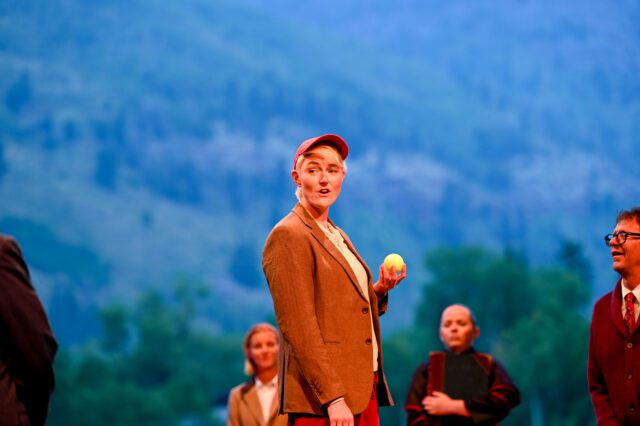
Julia as a fairly tweaked young Henry. The heir to the French throne gave Henry a gift of tennis balls to belittle the young English king by implying that Henry was still a frivolous playboy better suited for games than for warfare. Image courtesy Telluride Theatre.
At the dress rehearsal Thursday night, Julia’s Henry was at once disarmingly gentle and boldly, flatly commanding. She delivered every line with fresh intelligence and her body language, eerily androgynous, also signaled a monarch who is callow and therefore very dangerous:“Impatient to assert control.”
In 2019 as a Telluride Theatre newbie Julia charmed as Miranda, the love interest in “The Tempest.” In 2024, she played Viola as smart, steady survivor, who grieves deeply for her brother, yet still functions to great effect in the world. Julia’s Viola was the show’s true north, setting the production’s direction and serving as catalyst for every major plot change.
As is the case “Henry V.” (Well, that is Julia and Suzanne Cheavens’ Chorus.)
There are few more stirring summons to arms in all of Shakespeare, in fact in all of literature, than Henry’s speech to his troops on St. Crispan’s Day, an address which ends with the lyrical and timeless “We few, we happy few, we band of brothers…”
Critics universally agree to deliver that speech with aplomb is to pass the acid test for anyone with the balls (or not) to perform Henry in public. Not just the quietly forceful way she delivered those timeless words, but Julia’s body language also spoke volumes.
Those in attendance had chills.
“Henry V,” (also known as “The Life of Henry the Fifth”), is one of the better known of Shakespeare’s history plays. One simple reason is the plot is relatively straightforward: After being insulted by the French Dauphin, the young king declares war across France to claim the French throne, culminating in the Battle of Agincourt, which the Brits famously win despite the odds. Throughout this folio, we are given themes such as duty to one’s nation, social class structure, and the role of a leader.
“Henry V” opens with two clergymen deciding a foreign war would solve their domestic problem, then dressing their findings in a genealogical argument so spurious, so tedious their rationale becomes a running joke. Any audience who has watched a war’s stated reason for being get assembled after the decision was made to rumble will recognize the shape. Shakespeare does not argue the war is unjust — he just shows us the sausage being made, then asks us to be moved by the St. Crispin’s Day speech anyway.
And we are.
That is the trap the Bard sets, a notion underlined by a compelling and wholly believable arc throughout the play: the King begins his reign as a slightly immature and naïve monarch. Then, his confidence grows with experience, and his morals, initially clearly set out through demands to preserve the finer points of civilian life, begin to decay. And Henry descends into tyranny. A reflection on modern-day politics? Your call…
Returning director Jim Cairl’s bare-bones production of this history is replete with mock epic battle scenes, hilarious characters, deep introspective moments, even a love story to top it all off. It is, as established, a history lesson. But it is also a romp and a delight. Yes, in large part thanks to Julia’s Henry, a Sun King way before Louis XIV had that handle tattooed on his chest. But this adaptation is an ensemble effort, with Cairl’s cast once again – meaning as they were in last year’s hilarious“Two Gentlemen from Verona” – clearly in sync and having a ball whether playing it straight or camping it up.
In fact Cairl appears to be very good at directing an abundantly talented cast of locals towards flamboyant joy – while teaching a few pithy lessons en route.
Take for a prime example Cheavens’ Chorus. The character is unique to Henry V among the histories. Modern reviews have settled on the role as the play’s built-in irony machine, rather than cheerleader. The pattern: Chorus promises glory, the next scene delivers squabbling captains, a hanged friend, or a threat to impale infants.
Cognitive dissonance is the play.
Also Cheavens doubling is no accident. In fact it is the interpretive key to the production. Why? Because Chorus is the play’s patriotic hype-man; her Montjoy is the French herald who arrives repeatedly to tell Henry his cause is doomed and to ask him to name his ransom.
Putting two voices in one actor’s mouths means the voice selling you the myth and the voice pricing the myth in dead bodies, noble or not, are the same. Given the company’s own “bombastic pursuit of power” framing, Cairl had to have done that on purpose. Essentially the director made Cheavens’ whole job making the audience work – and later reflect. Piece out our imperfections with your thoughts. Divide one man into a thousand parts. Think, when we talk of horses, that we actually see them. We build the fleet. We build the army. Etc.
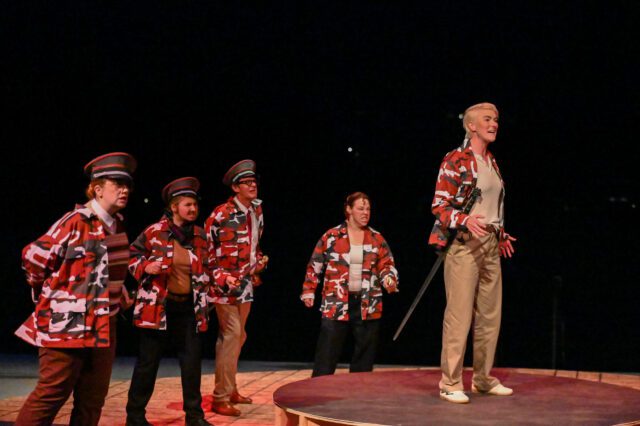
Henry’s fierce army, her band of brothers…, courtesy Telluride Theatre.
Having been complicit in building it all, we cannot later claim we were only watching. Innocent bystanders? Yeah right. We can pack up our water bottles and snacks and walk away when the curtain falls, but, in the end, we were and are co-conspirators.
Again, if the same voice that sells you the war is the voice that arrives to ask Henry’s ransom price, the Chorus is weaponized against itself. And because she has shown herself in production after production to be a chameleon, Cheavens, generally easy in her skin, is perfect for the schizophrenia her ponderous role – rather roles – demand.
“I like to say Julia Caulfield made me do it. And I’m so grateful I said yes to this challenging role in this incredible play with this wowza cast… To say I’m proud of what our cast and crew have created is a massive understatement. Come see for yourself. We have indeed invoked ‘a muse of fire,’ “said Cheavens on Facebook.
Another of Cairl’s many strengths as a director clearly is his casting, including newbies such as Rebecca Greubel, who plays the French princess Katherine. Her character offers up comic relief, especially in the long scene of flirtation and proposal between her and Henry in which the King butchers the French language.
(Of note for you trivia buffs regarding that scene: the real Henry spoke French. Fluently. He was a Plantagenet with vast French holdings. Shakespeare invented a monolingual Henry so the wooing scene would become a comedy about national character. But the truth is the actual Henry V was the very first English king since the Conquest to make English his official written language.)
Then there is Katherine’s English lesson, the only extended scene in Shakespeare to be performed entirely in French. The moment is an elaborate joke that tilts blue as when the princess mangles “foot” into foutre. (Look it up.) Fact is a young woman is being auctioned as a treaty term and is made to learn the language of her buyer – and that language compromises her.
Was the elaborate phrasemaking that went on funny? You betcha. But it was also a bit cruel.
Then there is Sue Knechtel, who should be arrested for stealing scenes. While she, as almost all of the cast members, plays multiple roles, in this production her role as Pistol’s wife, a gum-chewing, escapee from “The Sopranos,” takes the cake. Fagetaboutit.
“Henry V” features 13 actors charged with countries and armies to conjure. The list includes Sophie Iglar, (Dauphin); James Guest (Exeter); Taylor Fortenberry (Fluellen/Bedford); James Van Hooser (Pistol/Ambassador); Charlie Hodes (Bardolph); Dave Macmillan (Nym); Knechtel (Hostess); Kassidy Atherton (Gloucester); Susa Smith (Gower); and Simon Guest (Boy).
This is a cast that did not and will never coast

Henry’s uncle negotiating with the Dauphin. Credit Telluride Theatre.
And all are clearly and wholly aided and abetted by Cairl’s crew – Stage Manager Charolette Guest; Lighting Designer Kelli Fox; Sound Design, Robin Lemmez; Production Assistant Adin Sterling; and Scott Upsure for Set Design, a bare stage that is close to the Bard’s Globe, which was an outdoor amphitheater.
Clever.
That means rain or shine, ambient noise from the park or no, a “wooden O,” and no fourth wall too break (because none was built), grounds this production close to 1599, the date scholars say Shakespeare wrote this history. Closer than any of the many served up on a lit proscenium.
Again, kudos to Cairl, Caulfield, cast and crew for this muscular, profound, yet profoundly entertaining production that delivers way more than history. We are convinced the reason “Henry V” matters is that, over time, the play has become one of the most reliable barometers from The Bard’s canon for how a culture feels about war.
Yes “indeed The game’s afoot” and we leave having been complicit in something we can now also critique.
The paradoxes encased in everyday headlines step onto the boards.
Sorry, the comment form is closed at this time.