

31 Jul Telluride Science Town Talk: “The Tiny Machines That Keep Us Alive,” 8/4!
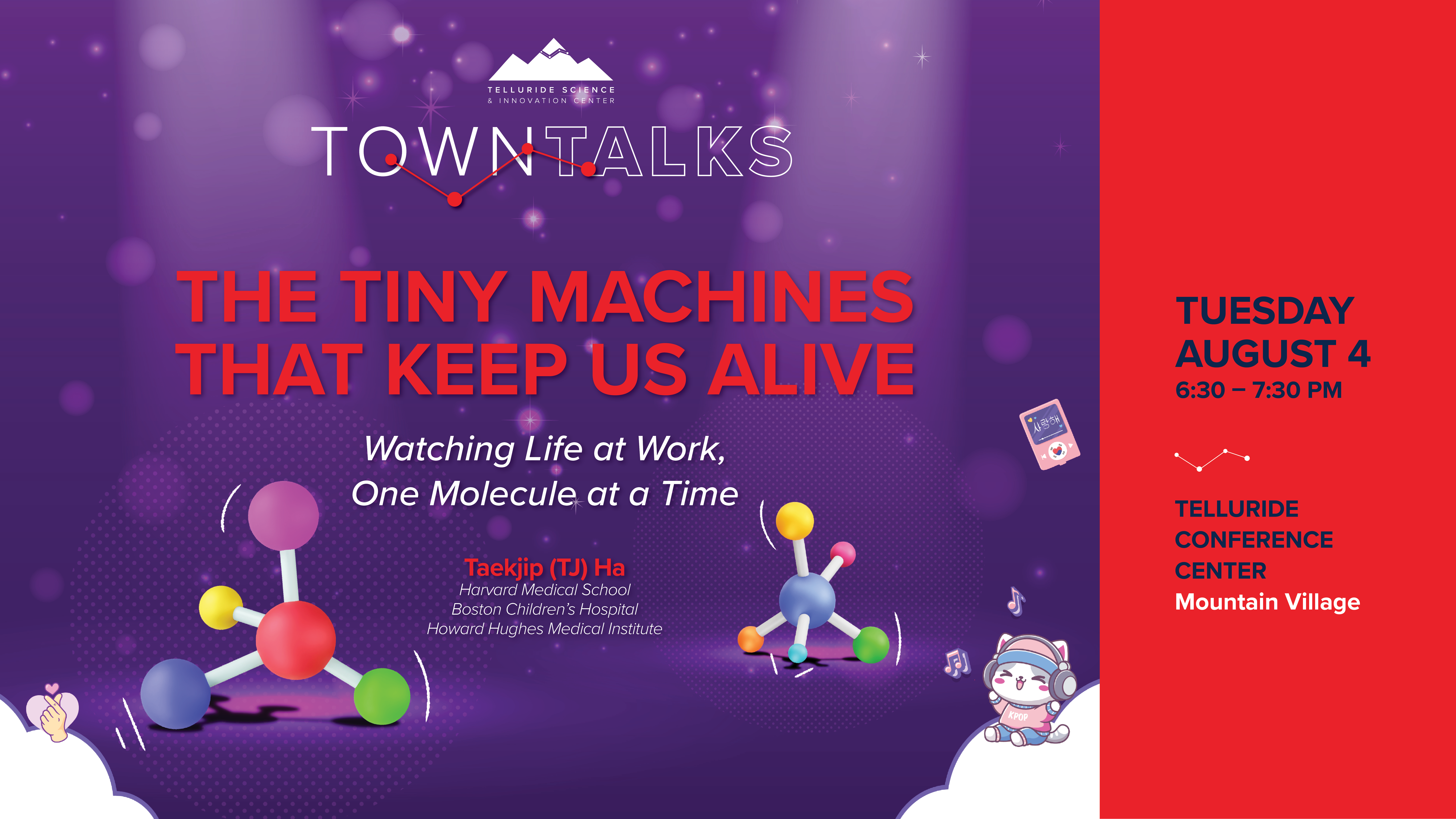
This coming week the 2026 Telluride Science Town Talks series continues with “The Tiny Machines That Keep Us Alive: Watching Life at Work, One Molecule at a Time.” The event features Dr. Taekjip (TJ) Ha from the Boston Children’s Hospital.
Talk takes place Tuesday, August 4. Doors 6 p.m.; talk, 6:30- 7:30 p.m.
Town Talks are FREE and open to the public.
Visit telluridescience.org to learn more about Telluride Science and the historic Telluride Depot, now the Telluride Science & Innovation Center. The venue is the permanent home for Telluride Science and a global hub of inspired knowledge exchange and development where great minds get to solve great challenges.
The 2026 Telluride Science Town Talks series is presented by Alpine Bank with additional support from the Telluride Mountain Village Owner’s Association.
Go here for more about Telluride Science.
Go here for more on Town Talks.
The same answer applies to any question you might have about your body: proteins.
Proteins are nature’s nanomachines. More than 20,000 of these special molecules in our bodies help us think, dance, and keep the threat of cancer and other diseases at bay. They specialize in different tasks, from noticing the spice in chilli peppers that can cause pain to breaking down alcohol.
In his Telluride Science Town Talk on August 4, “The Tiny Machines That Keep Us Alive: Watching Life at Work, One Molecule at a Time,” Dr. Taekjip (TJ) Ha will discuss how biophysicists are now using light-based tools to poke and examine proteins. He will also explain how watching a single protein at work could one day help scientists catch and treat mutations that lead to a wide variety of diseases.
At Boston Children’s Hospital, Ha focuses on the specific proteins guarding blood-forming stem cells, pinpointing where cell replication errors open the door to leukemia and other chronic diseases in children. He does that by using the aforementioned light-based tools to watch proteins do their acrobatics in real time.
It is important to note proteins are extremely hard to measure, especially when Ha is trying to capture them at particular points in chemical changes. The challenge is size: if you were to scale a body to planet Earth, one protein is about the size of the human body. So watching proteins through a microscope is like trying to watch someone playing tennis on Earth from a telescope in space.
Once upon a time, Ha was a physicist building an instrument meant to study semiconductors. That instrument turned out to be exactly what was needed to study proteins. He had built a tool to address the new challenges in this phase of his professional life. It tags proteins with glowing dyes and lasers and then he films them in action, catching movements an ordinary microscope can not come close to detecting.
The same technology has allowed Ha to witness DNA repair proteins. In that context, they act as built-in guard rails against cell damage. By patrolling our DNA, these proteins can fix errors before they take hold. When guardrails fail, consequences can be as serious as any of many debilitating diseases. In breast cancer, for example, a single six letter mutation in a gene can dramatically increase a person’s risk of breast or ovarian cancer.
Join Ha to see how a scientist once fascinated by semiconductors is now revealing nanomachines of life and why watching one protein at a time could one day help defeat many of the bad actors in our bodies.
Dr.TJ Ha, more:
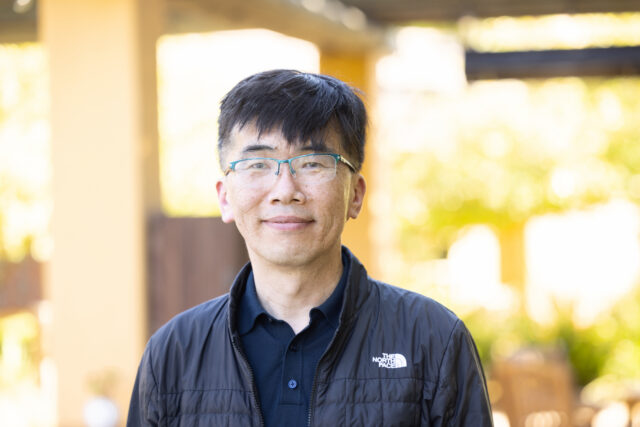
Taekjip (TJ) Ha is the Director of the Program in Cellular and Molecular Medicine at Boston Children’s Hospital, and he holds the George D. Yancopoulos, MD, PhD Professorship of Pediatrics at Harvard Medical School. Ha has been a Howard Hughes Medical Institute (HHMI) Investigator since 2005, and he is a member of the National Academy of Sciences and the National Academy of Medicine.
Ha did his BS in Physics at Seoul National University and earned his PhD in Physics at the University of California, Berkeley in 1996. During his postdoc studies at Stanford University, his interest in biology took hold when an instrument he was helping build to study semiconductors turned out to be ideal for watching single molecules in action.
Before joining the faculty at Harvard and Boston Children’s Hospital in 2023, he was a Bloomberg Distinguished Professor of Biophysics and Biomedical Engineering and a Professor of Physics at the University of Illinois Urbana-Champaign.
Caroline Simmons, more:
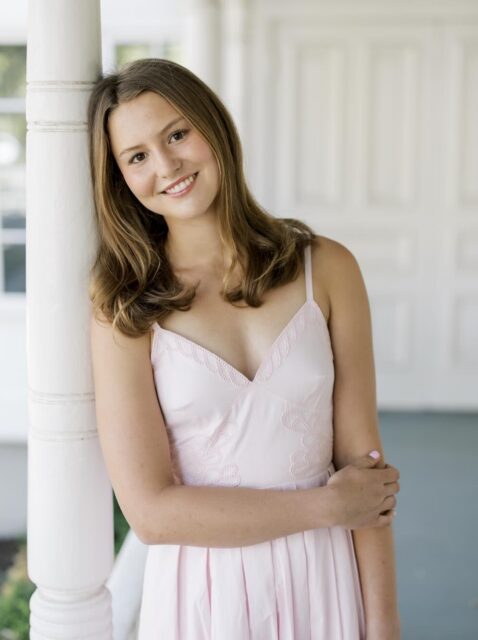
Caroline Simmons is from Austin, Texas, and has grown up spending as much time in Telluride as possible.
She is a rising second-year at the University of Richmond, where she plays field hockey and is planning on studying Biology and Health Studies.
Sorry, the comment form is closed at this time.