
13 Feb TIO AZ: Sedona FF, Workshop w/Editor Sandra Adair!
Helmed by Executive Director Peter Schweiss for 22 years of its 32 years, the Sedona Film Festival, (SFF), 2/21 – 3/1, has become world-renowned for bringing award-winning films and meaningful conversations to its growing community through filmmaker Q & As, workshops and seminars.
The celebrated editor and director Richard Linklater’s right arm, Sandra Adair, will be in town for the first time to lead a workshop about editing titled “From First Cut to Final Frame: A Film Editor’s Workflow.” The event takes place on Saturday, 2/28, 4 p.m. at Yavapai College, Sedona Center.
Go here to check out the full festival schedule.
Scroll down to learn more about her process and her unique relationship with Linklater in a podcast featuring Sandra Adair. Also learn more about about Patrick Schweiss.
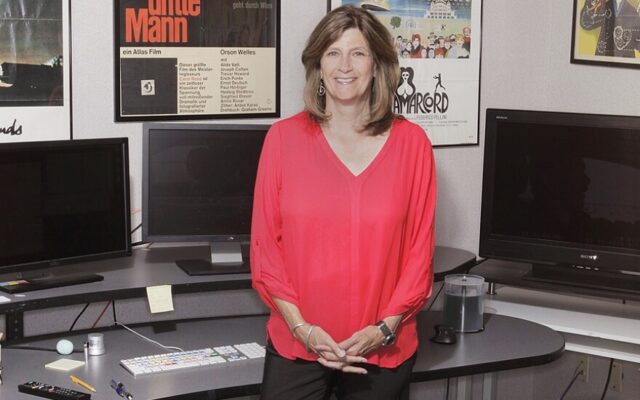
Sandra Adair, on the job. Courtesy Sedona Film Fest.
She is an architect of conversational cinema, which means she helped defined the editing language of talk-driven narrative film.
Her cuts favor emotional truth over showmanship.
As a pioneer of longitudinal storytelling, “Boyhood” remains a landmark editorial achievement and her decades-long collaboration with Richard Linklater is one of The Industry’s greatest , most enduring director-editor partnerships in modern film history.
She is the celebrated film editor Sandra Adair, whose path into film editing was not through traditional studio pipelines, rather through the American indie film movement that flourished in the late 1980s and early 1990s.
Adair developed her craft working in Texas-based production circles, where Linklater and other regional filmmakers were building a new, dialogue-driven form of independent cinema.
Among the very first properties Adair and Linklater developed together was the coming-of-age ensemble film “Dazed and Confused” (1993).
In “Before Sunrise” (1995) two strangers meet on a train and spend one night walking and talking through Vienna. Adair’s editing preserves conversational flow and real-time intimacy, a hallmark of the trilogy.
A rare studio comedy on her résumé, “School of Rock” (2003) balanced improvisational performance (Jack Black) with tight comedic timing.
“Before Sunset” (2004) was set almost entirely in real time, the film demanding precision pacing without visible cutting. Adair’s work sustains emotional tension through restraint rather than montage.
The 2011 movie “Bernie” is a documentary that showcases Adair’s ability to emerge tonal registers.
And then there was Adair-Linklater’s landmark achievement “Boyhood” (2014). Filmed over 12 years with the same cast, the film chronicles a boy’s growth from childhood to college.
Just imagine the editorial challenges of shaping 12 years of footage into a cohhesive emotional arc while avoiding artificial transitions or gimmicks to deal with aging. For “Boyhood” to succeed Adair had to allow time itself function as a key component within the narrative structure.
In the end, Adair’s editing of “Boyhood” was widely credited with making the film’s longitudinal experiment emotionally legible and coherent.
A number of other noteworthy collaborations following including “Where’d You Go Bernadette” and the recent “Blue Moon.” The latter, a chamber-style musical biographical drama centered on legendary Broadway lyricist Lorenz Hart (of Rodgers & Hart fame), was set largely over the course of a single evening as he confronts career decline, romantic longing, and artistic legacy. The film starred Ethan Hawke as the beleaguered genius is yet another career-defining role.”Blue Moon” premiered at the Telluride Film Festival to universal hosannas.
Linklater has often credited Adair with “discovering the film within the footage.”
How does Adair pull off that hat trick? Find out more by attending the workshop she is leading in Sedona – and by checking out her podcast below.
Patrick Schweiss, more:
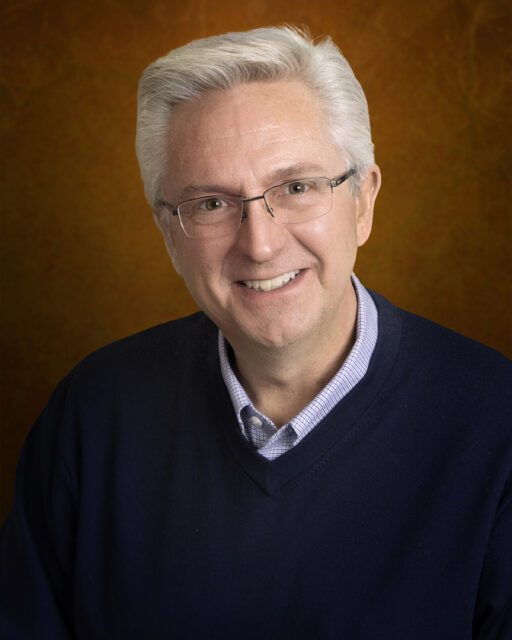
Patrick Schweiss, courtesy SFF.
Patrick Schweiss is executive director of the Sedona International Film Festival and theaters.
He took the helm at the festival 22 years ago and has overseen its growth from a 3-day festival to a 9-day celebration of independent film.
In 2012, Schweiss initiated and oversaw the festival organization as it built its own arthouse theatre venue – The Mary D. Fisher Theatre – where it presents year-round independent films, theatrical and ballet productions on screen from around the world, live simulcasts and live theatrical events, as well as other arts and cultural events.
In June 2022, the festival opened its newest addition: the Alice Gill-Sheldon Theatre. Now the event has two theatre venues that operate daily all year long!
Through the theatres, Schweiss has been able to bring cultural events to Sedona that may not otherwise have been seen by residents and tourists, including the Met Live Opera, Bolshoi and Royal Ballet productions, National Theatre of London, Broadway on Screen productions, Exhibition on Screen and Great Art on Screen exhibits, The Globe and Royal Shakespeare Company productions, live simulcasts and events as well as live theatrical and musical concerts.
Not to mention the main offerings at the theatre: the best independent films from around the word.
In addition, Schweiss has spearheaded collaborations with several other non-profit organizations in Sedona to co-produce and present events at the theatre.
Sorry, the comment form is closed at this time.