


25 Jan TIO AZ: Healing Times Two!
Sedona has drawn people the way landscapes draw light: quietly and consistently, suggesting a kind of open promise highlighting natural beauty. Its signature red rock formations feel less like scenery than a magical, mystical presence: sculptural, attentive. In other words, Sedona is a place of clarity, stillness, and reset. A place to heal.
Did you know that copper is the backbone of the state’s identity? Yes indeed, Arizona is known as “The Copper State” for good reason. Copper mining was not a side story – it was one of the main engines of Arizona’s growth. And, in keeping with the theme of this story, copper is healing partly because the mineral, the very first discovered by man, is biologically necessary and naturally antimicrobial; and partly because cultures have long treated copper as a conductor of vitality, protection, and balance.
This is the first in a series of posts from Arizona, a second home. Expect lots more, including interviews featuring guests of the upcoming Sedona Film Festival, 2/21 – 3/1.
Interested? Tickets/passes here.
Amitabha Stupa and Peace Park
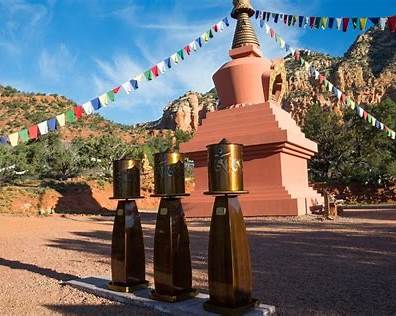
People come to Sedona for sunrise hikes and stunning overlooks, but also for what amounts to an atmospheric stillness. The Amitabha Stupa and Peace Park fit perfectly into that underlying vibe.
Construction on the venue began in 2003, with the main 36-foot Amitabha Stupa completed and consecrated in 2004 after a multi-day ceremony involving prayers and offerings.
For the record, a stupa is a Buddhist sacred monument. They are typically domes or mound-like structures built to honor enlightenment, commemorate a holy figure or sacred event, and serve as a focus for meditation and prayer. Traditionally, stupas may hold relics or sacred objects. Many who visit practice circumambulation (walking clockwise around the stupa) as a form of moving meditation.
Built as a spiritual monument dedicated to peace and compassion, the Amitabha Stupa is open to all, regardless of religion, and invites guests and locals to a gentler form of exploration. In a region that often feels theatrical – read red-rock grandeur – the stupa offers something rare: an uncommercial place to stand in silence and awe.
Sedona’s stupa was created as a spiritual monument dedicated to peace, compassion, and healing, conceived by Jetsunma Ahkon Lhamo, the spiritual director of the Tibetan Buddhist organization Kunzang Palyul Choling. It was intended to be a place of prayer, meditation, and renewal open to people of all faiths, where visitors can reflect, find inner peace, and offer intentions for the well-being of others.
In the Buddhist tradition, stupas such as the Amitabha Stupa, are believed to embody the enlightened mind, to purify negativity, and to support compassion and spiritual awakening in those who come near them or meditate around them. The Sedona location, amid the region’s dramatic landscape, was chosen both for its beauty and for the sense of peace and sacredness that draws pilgrims and seekers from around the world.
Amitabha is a celestial Buddha associated with infinite light, compassion and peaceful rebirth or liberation from the wheel of life.
So the stupa is not just a pretty structure in the very pretty red rock country. The venue is meant to be a physical symbol of peace and compassion placed into a dramatic natural setting. A much needed balm to our troubled times.
Think of the place as spiritual exclamation point.
Certainly was for us when we visited the site on a balmy Arizona afternoon.
Arizona Copper Art Museum:
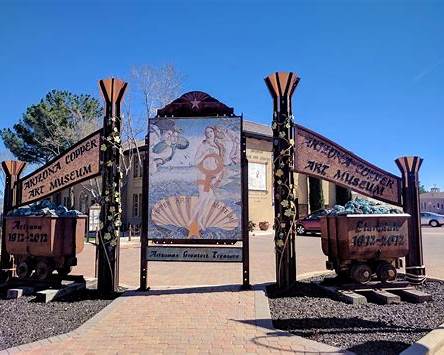
The Arizona Copper Art Museum in Clarkdale is one of those uniquely Arizona places where industry, artistry, and frontier ambition meet. The venue is not just about copper as a metal. It is about copper as the material that helped build a state, power it, populate it, and define its economic identity for over a century.
The metal was essential to electrification (wiring, power transmission); railroads and industrial expansion; construction and plumbing; and wartime manufacturing.
Walk into a museum and you are entering a place dedicated to Arizona’s economic origin story. Clarkdale is not just near mining history; the town was created by it. Copper is the very reason Clarkdale became Clarksdale in the first place.
Mining history with the associated blasting, labor, boom-and-bust economics is only one part of the story. What the Copper Art Museum does is show the other side of that coin: what happens when raw material becomes household objects, ornaments and art.
The museum then reframes copper from extraction into creation, a more complete, more relatable version of the state’s story that includes towns, railways, jobs and migration, wealth, modern infrastructure.
Copper is healing for two distinct reasons: one is real and physical; the other traditional/energetic (and more belief-based).
Copper has a genuine, well-documented ability to kill or disable many microbes (bacteria and some viruses/fungi) on contact, reducing germ survival and helping to prevent contamination. It is also a trace mineral our bodies needs in small amounts for collagen and connective tissue like skin, joints, blood vessels; iron metabolism, which is important for healthy red blood cells; energy production or cellular metabolism; the function of the nervous system and antioxidant defense.
The Arizona Copper Art Museum’s story begins not in Clarkdale, but in 1958. Back then, John and Patricia Meinke of Minnesota discovered several copper molds in an antique shop and became captivated. That spark inspired Pat to open a small antique shop focused on copper pieces, and over the ensuing decades the Meinkes – and later, their son, Drake – built an extensive collection of copper artifacts from Europe and North America.
By the early 2000s, the collection had grown so large and rich that the family began looking for a permanent home where their copper bonanza could be shared with the public.
The Arizona Copper Art opened its doors in 2012, coinciding with the centennial celebrations of both Clarkdale and the state of Arizona. The collection now includes over 5,000 copper artifacts spanning ancient history to modern artistic works, showing copper’s role not only as an industrial metal, but also as a medium for craft, design, health, wealth and ingenuity.
We found the place interesting, if a bit overwhelming, a tsunami of copper stuff that was not and remains uncurated. Yes, the objects are organized by category, but nothing appears to have been edited or reviewed by an expert. The signage is ok, but for the most part visitors are on their own to find the stand-outs.
Sorry, the comment form is closed at this time.